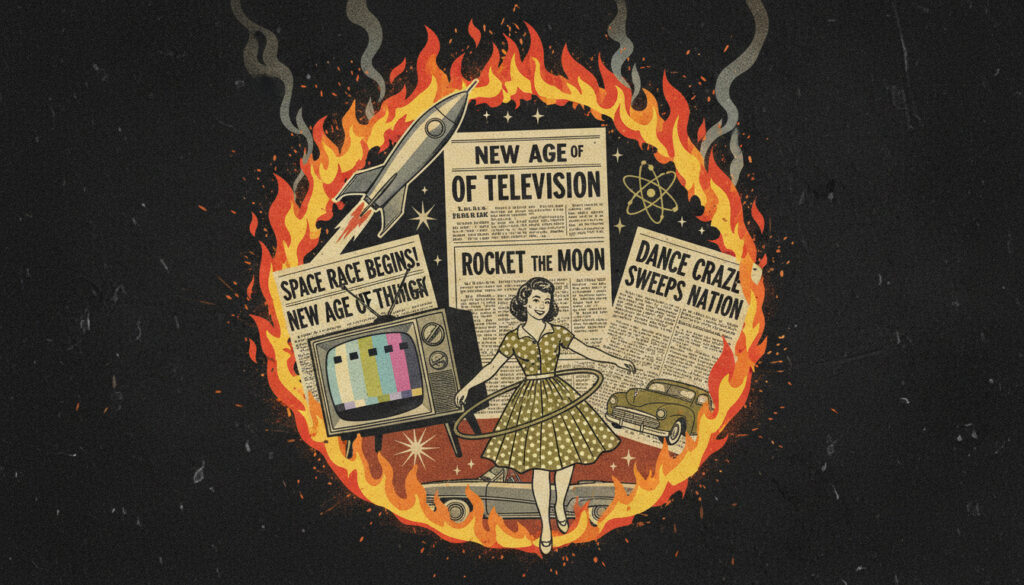
We Didn’t Start the Fire Lyrics – Full Text, History and Meaning
“We Didn’t Start the Fire” compresses four decades of global history into a rapid-fire four-minute track that dominated airwaves upon its 1989 release. Billy Joel’s composition lists 119 historical, cultural, and political references in chronological order, creating a musical timeline that argues baby boomers inherited world problems rather than creating them.
The song emerged from Storm Front, Joel’s eleventh studio album, at a moment when the artist sought to counter generational misconceptions. Its structure abandons traditional storytelling in favor of a relentless catalog of headline events, scientific breakthroughs, and cultural milestones spanning from Harry Truman’s presidency through the Reagan era.
Decades after reaching number one on the Billboard Hot 100, the track remains a subject of academic and popular analysis, with listeners continuing to dissect the specific historical allusions packed into each verse.
What Are the Full Lyrics to We Didn’t Start the Fire?
The complete text consists of six verses separated by the recurring chorus, presenting a near-exhaustive list of people, places, and events that shaped the post-World War II era.
Key Insights
- The composition contains exactly 119 discrete historical references according to Encyclopedia Britannica and Wikipedia analyses.
- Entries follow strict chronological order from 1949 (Joel’s birth year) through 1989.
- The track earned a Grammy nomination for Record of the Year and reached number one on the Billboard Hot 100.
- Joel later expressed dissatisfaction with the melody, describing it as “not that good melodically” despite commercial success.
- The structure functions as a “list song,” a compositional technique emphasizing historical continuity over narrative progression.
- No official sequel exists from Joel, though Fall Out Boy released a 2023 continuation covering events from 1989 to 2023.
- The chorus explicitly absolves the baby boomer generation of responsibility for igniting global conflicts.
Quick Facts
| Attribute | Detail |
|---|---|
| Single Release | September 18, 1989 |
| Album Release | October 17, 1989 |
| Album Title | Storm Front |
| Record Label | Columbia |
| Song Length | 4:50 |
| Chart Position | #1 Billboard Hot 100 (Third #1 for Joel) |
| Grammy Status | Nominated for Record of the Year |
| Historical References | 119 items (1949–1989) |
| Composer | Billy Joel |
| Publisher | Universal Music Publishing Group |
Complete Lyrics
Harry Truman, Doris Day, Red China, Johnnie Ray
South Pacific, Walter Winchell, Joe DiMaggio
Joe McCarthy, Richard Nixon, Studebaker, Television
North Korea, South Korea, Marilyn Monroe
Rosenbergs, H-Bomb, Sugar Ray, Panmunjom
Brando, The King And I, and The Catcher In The Rye
Eisenhower, Vaccine, England’s got a new queen
Marciano, Liberace, Santayana goodbye
We didn’t start the fire
It was always burning, since the world’s been turning
We didn’t start the fire
No we didn’t light it, but we tried to fight it
Joseph Stalin, Malenkov, Nasser and Prokofiev
Rockefeller, Campanella, Communist Block
Roy Cohn, Juan Peron, Toscanini, Dacron
Dien Bien Phu Falls, Rock Around the Clock
Einstein, James Dean, Brooklyn’s got a winning team
Davy Crockett, Peter Pan, Elvis Presley, Disneyland
Bardot, Budapest, Alabama, Khrushchev
Princess Grace, Peyton Place, Trouble in the Suez
We didn’t start the fire
It was always burning, since the world’s been turning
We didn’t start the fire
No we didn’t light it, but we tried to fight it
Little Rock, Pasternak, Mickey Mantle, Kerouac
Sputnik, Zhou En-lai, Bridge On The River Kwai
Lebanon, Charles de Gaulle, California baseball
Starkweather homicide, Children of Thalidomide
Buddy Holly, Ben Hur, Space Monkey, Mafia
Hula hoops, Castro, Edsel is a no-go
U2, Syngman Rhee, Payola and Kennedy
Chubby Checker, Psycho, Belgians in the Congo
We didn’t start the fire
It was always burning, since the world’s been turning
We didn’t start the fire
No we didn’t light it, but we tried to fight it
Hemingway, Eichmann, Stranger in a Strange Land
Dylan, Berlin, Bay of Pigs invasion
Lawrence of Arabia, British Beatlemania
Ole Miss, John Glenn, Liston beats Patterson
Pope Paul, Malcolm X, British politician sex
JFK – blown away! What else do I have to say?
We didn’t start the fire
It was always burning, since the world’s been turning
We didn’t start the fire
No we didn’t light it, but we tried to fight it
Birth control, Ho Chi Minh, Richard Nixon back again
Moonshot, Woodstock, Watergate, punk rock
Begin, Reagan, Palestine, Terror on the airline
Ayatollah’s in Iran, Russians in Afghanistan
Wheel of Fortune, Sally Ride, heavy metal suicide
Foreign debts, homeless Vets, AIDS, Crack, Bernie Goetz
Hypodermics on the shores, China’s under martial law
Rock and roller cola wars, I can’t take it anymore
We didn’t start the fire
It was always burning, since the world’s been turning
We didn’t start the fire
But when we are gone
It will still burn on, and on, and on, and on
And on, and on, and on, and on…
Source: Storm Front (Columbia LP, words/music by Billy Joel, © Universal Music Publishing Group). Full verse-by-verse breakdowns available in our We Didn’t Start the Fire Lyrics – Full Text and Historical References companion piece.
What Historical Events Are Referenced in the Lyrics?
The 119 items encompass political figures, scientific achievements, sporting milestones, and entertainment landmarks arranged in near-chronological sequence.
Post-War Era and the Early Cold War (1949–1959)
The opening verse anchors the narrative in Harry Truman’s presidency and the early tensions of the Cold War. References include the Soviet atomic program (H-Bomb), the Rosenberg espionage trial, the Korean War (North Korea, South Korea, Panmunjom), and the cultural impact of figures like Joe DiMaggio and Marilyn Monroe. The Association for Diplomatic Studies and Training notes that “Red China” marks the 1949 Communist victory under Mao, while “England’s got a new queen” references Elizabeth II’s 1952 coronation.
The Space Race and Cultural Revolution (1950s–1960s)
Subsequent verses capture the launch of Sputnik in 1957, the rise of Fidel Castro, and the assassination of John F. Kennedy (“JFK – blown away”). Scientific and cultural milestones appear alongside geopolitical crises: the song analysis from Hot 104.7 confirms that “Children of Thalidomide” references the 1961 pharmaceutical disaster, while “British Beatlemania” marks the 1964 cultural invasion.
The 119 entries span politics (Cold War leaders, conflicts), culture (Elvis Presley, Disneyland), science (Sputnik, vaccines), and sports (Sugar Ray, Marciano). Britannica’s complete breakdown verifies each item from Truman through the 1980s “cola wars,” requiring no external knowledge for historical confirmation.
Vietnam and Social Upheaval (1960s–1970s)
Later verses document escalation in Vietnam (Ho Chi Minh), the Woodstock festival, and the Watergate scandal. The lyrics move through civil rights milestones and space exploration achievements, maintaining the rapid-fire pace that characterizes the composition’s structure.
The 1980s and Conclusion
The final verse addresses the AIDS crisis, the Soviet-Afghan War (“Russians in Afghanistan”), and the “rock and roller cola wars” referencing the Pepsi versus Coca-Cola celebrity advertising battles featuring Michael Jackson. The chronology concludes in 1989, the year of the song’s release.
What Does We Didn’t Start the Fire Mean?
Billy Joel structured the composition as a direct rebuttal to generational fatalism, arguing that contemporary turmoil represented a continuation of historical patterns rather than a unique modern failure.
The Central Thesis
The recurring chorus—”We didn’t start the fire / It was always burning, since the world’s been turning”—establishes the song’s primary argument. Joel explicitly absolves the baby boomer generation of responsibility for creating global chaos, emphasizing instead their role in attempting to combat ongoing problems. The fire metaphor suggests that conflict and crisis predate any single generation’s influence.
Origins of the Concept
The inspiration emerged during Joel’s fortieth birthday celebration in a recording studio. According to diplomatic archives, a 21-year-old acquaintance of Sean Lennon complained that the late 1980s constituted a “terrible time” while claiming that “nothing happened in the fifties.” Joel, a self-described history enthusiast, formulated the track as a demonstration that every era faces equivalent turbulence.
Joel selected the “list song” format specifically to overwhelm the listener with evidence of perpetual crisis. By compressing 40 years of headlines into rapid succession, he sought to prove that the 1950s contained precisely as much chaos—political, cultural, and scientific—as the 1980s.
Critical Reception and Joel’s Assessment
Despite its commercial triumph, Joel later expressed reservations about the composition’s musical merits. Critics and the artist himself characterized the melody as weaker than his other work, with Joel specifically calling it “not that good melodically.” Nevertheless, the track earned a Grammy nomination for Record of the Year and became his third single to top the Billboard Hot 100.
Who Sings We Didn’t Start the Fire and When Was It Released?
Billy Joel wrote, composed, and performed the track, which served as the lead single from his eleventh studio album.
Release Details
Columbia Records released the single on September 18, 1989, with the full album Storm Front following on October 17, 1989. The recording sessions marked a distinctive period in Joel’s career, as he approached the project with the specific intent of creating a historically grounded counter-argument to generational stereotypes.
Commercial Performance
The single drove the album to become Joel’s third U.S. number one record. Its chart dominance persisted through early 1990, cementing its status as a definitive cultural marker of the era’s closing months. The track remains a staple of Joel’s concert performances and classic rock radio programming.
Is There a Sequel to We Didn’t Start the Fire?
Billy Joel declined to produce an official follow-up, though the song’s format has inspired direct continuations by other artists.
Joel’s Position
Despite suggestions to extend the timeline into the 1990s and beyond, Joel maintained that one iteration was sufficient. As documented in interview archives, the artist expressed satisfaction with the original scope and declined to update the chronology.
The Fall Out Boy Continuation (2023)
In 2023, Fall Out Boy released a cover and sequel that maintains Joel’s rapid-fire list structure while extending the historical timeline from 1989 through 2023. Their version incorporates references to events of the subsequent three decades, functioning as an unofficial continuation authorized by the band’s interpretation rather than by Joel.
Joel has formally declined all proposals to extend the lyrics beyond 1989. Any continuations, including the 2023 Fall Out Boy version, constitute interpretive homages rather than canonical extensions of the original work.
When Do the Events in We Didn’t Start the Fire Take Place?
The lyrical timeline follows strict chronological progression from Joel’s birth year through the song’s release.
- 1949–1953: Truman administration, Soviet atomic bomb development, Korean War outbreak, Rosenberg trial, and the rise of television as mass media.
- 1953–1959: Eisenhower era, English coronation, launch of Sputnik, Castro’s Cuban revolution, and the escalation of Cold War tensions.
- 1960–1963: Kennedy election and assassination, Bay of Pigs invasion, space race milestones including John Glenn’s orbit, and early Vietnam escalation.
- 1964–1969: British Invasion music culture, Civil Rights Movement references, heavy U.S. involvement in Vietnam, and the Woodstock generation’s emergence.
- 1970–1977: Nixon’s return to politics, Watergate scandal, Middle East conflicts, and the conclusion of the Vietnam War era.
- 1978–1989: Reagan administration, AIDS crisis, Soviet-Afghan War, terrorism in aviation, and the commercial culture wars of 1980s advertising.
What Is Factually Established Versus Unclear About We Didn’t Start the Fire?
While most references are historically verifiable, certain elements remain subject to interpretation.
| Established Information | Information Remaining Unclear |
|---|---|
| 119 discrete historical references (per Britannica) | Minor counting variations (some analyses cite 118 items depending on grouping methodology) |
| Chronological structure from 1949 through 1989 | Specific identity of the “British politician sex” referenced in the 1960s verse |
| Release dates: September 18, 1989 (single) and October 17, 1989 (album) | Joel’s precise subjective assessment of the melody’s quality (described variously as “weak” or “not that good”) |
| Grammy nomination for Record of the Year | Whether Joel will ever authorize an official update or sequel |
| Inspiration drawn from conversation with Sean Lennon’s friend | Complete accuracy of attributed quotes regarding the songwriting process |
| Fall Out Boy’s 2023 release as unofficial continuation | Commercial impact of cover versions on the original’s legacy metrics |
Why Did Billy Joel Write We Didn’t Start the Fire?
The composition emerged from Joel’s dual identity as a pop composer and history enthusiast, crystallized during a specific generational confrontation.
Having turned forty in 1989, Joel encountered a young friend of Sean Lennon who dismissed the 1950s as culturally and historically vacant while bemoaning the contemporary era’s turbulence. This conversation prompted Joel to demonstrate that the mid-century period contained equivalent doses of political crisis, technological change, and cultural upheaval.
The project allowed Joel to process his own historical consciousness, born in 1949, into a format that educated while entertaining. Selecting the “list song” structure enabled him to accumulate evidence rapidly, preventing counter-arguments through sheer density of reference. F1 Film – Brad Pitt Stars in Movie Shot at Real GPs
What Did Billy Joel Say About Writing the Song?
Primary sources and contemporary interviews reveal Joel’s complex relationship with his creation.
“It was always burning, since the world’s been turning.”
— Billy Joel, “We Didn’t Start the Fire” (chorus)
Joel has consistently maintained that the lyrics respond to a specific misconception about historical tranquility. He described the writing process as compiling a “list of what’s bugging me” about contemporary complaints regarding modernity.
“Not that good melodically.”
— Billy Joel, on the song’s composition (via archived interviews)
This self-criticism notwithstanding, Joel acknowledged the track’s educational value, noting that teachers utilized the lyrics to engage students with twentieth-century history.
What Is the Legacy of We Didn’t Start the Fire?
The composition endures as both a commercial pop hit and an educational tool, transcending its initial chart performance to become a cultural shorthand for baby boomer historical consciousness. Its format has inspired numerous parodies, classroom curricula, and the 2023 Fall Out Boy continuation, while Joel’s refusal to update the lyrics preserves the work as a time capsule of 1989 perspective. We Didn’t Start the Fire Lyrics – Full Text and Historical References
Frequently Asked Questions
Is there a We Didn’t Start the Fire 2?
No. Billy Joel declined to create an official sequel, stating one was sufficient. Fall Out Boy released an unofficial continuation in 2023 covering 1989–2023.
What album is We Didn’t Start the Fire on?
Storm Front, released October 17, 1989. The single preceded the album by one month.
How many historical references are in the song?
Sources confirm 119 discrete references, though some analyses count 118 depending on grouping methods.
What year does the song start and end?
The timeline begins in 1949 with Harry Truman and concludes in 1989 with the “rock and roller cola wars.”
Did We Didn’t Start the Fire win a Grammy?
It was nominated for Record of the Year but did not win. It did reach #1 on the Billboard Hot 100.
Who is the British politician mentioned in the sex scandal?
The specific identity remains ambiguous in the lyrics, fitting the rapid-fire ambiguity of the list format.
What inspired the specific list of events?
A conversation with a 21-year-old who claimed “nothing happened in the fifties” prompted Joel to prove every era contains equivalent chaos.
Does the song have a traditional chorus?
Yes, the “We didn’t start the fire” refrain repeats between verses, though the verses themselves contain no repeated lines.
More related posts
 Barre Classes Near Me: Dublin Guide & Comparison
 Museum of Science and Industry Chicago: Hours & Tickets
 Crying in H Mart: Summary, Themes, and Reader Guide (2025)
 What Is Gross Income – Definition, Calculation and Examples
 Saoirse-Monica Jackson: Bio, Pronunciation & Husband
 Psalm 28:7 Meaning: Strength, Shield, and Joy Explained
 Carolina Panthers vs Jacksonville Jaguars Player Stats Sep 2025
 Ralph Lauren Bear Sweater: Styles, Authenticity, and Buying Guide
