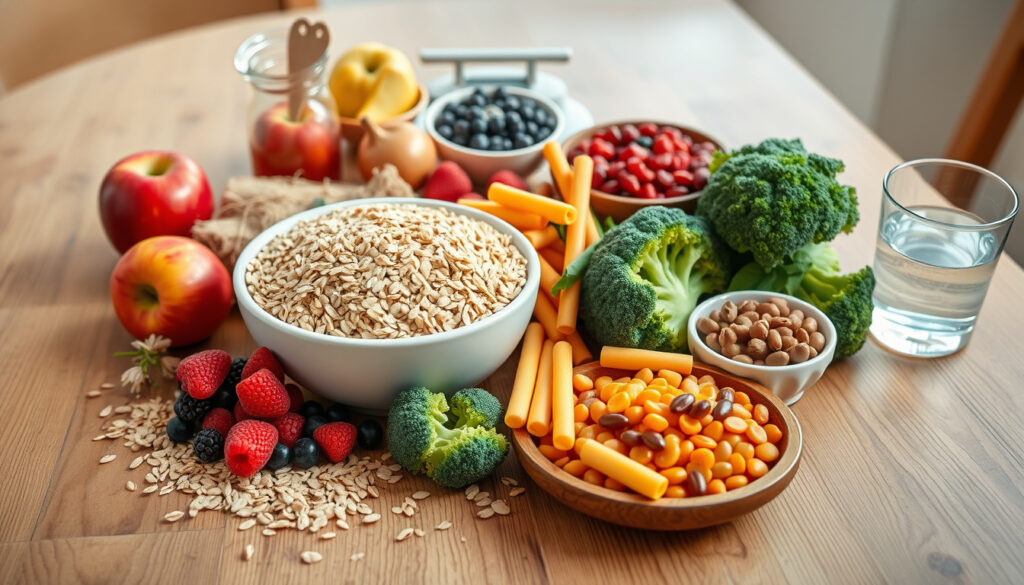
How Much Fiber Per Day? Daily Intake Guide
Most Americans eat roughly 15 grams of fiber a day—about half of what’s recommended. This guide lays out exactly how much you need by age and gender, shows what that looks like on a plate, and flags the warning signs your body sends when you fall short.
Women’s daily fiber target: 25 grams ·
Men’s daily fiber target: 38 grams ·
UK guideline: 30 grams ·
Average US intake: 15 grams ·
Fiber per 1,000 calories: 14 grams
Quick snapshot
- Women: 25g (Cleveland Clinic (medical center))
- Men: 38g (Cleveland Clinic (medical center))
- UK: 30g (NHS (U.K. health authority))
- Children: vary by age (PubMed Central review (academic research))
- Lentils (16g/cup, cooked) (NHS (U.K. health authority))
- Raspberries (8g/cup) (Harvard Nutrition Source (university research))
- Bran cereal (14g/3/4 cup) (Dietary Guidelines for Americans (federal policy))
- Avocado (10g/cup) (Clemson HGIC (university extension))
- Constipation (NHS (U.K. health authority))
- Irregular stools (NHS (U.K. health authority))
- Hard/dry stool (NHS (U.K. health authority))
- Bloating (NHS (U.K. health authority))
- Add fruits/veggies (NHS (U.K. health authority))
- Switch to whole grains (NHS (U.K. health authority))
- Include legumes (NHS (U.K. health authority))
- Drink plenty of water (NHS (U.K. health authority))
Five key facts, one pattern: no matter which country you check, fiber targets hover around 14 grams per 1,000 calories, but actual intake lags behind by a wide margin.
| Fact | Value |
|---|---|
| Recommended daily fiber for women | 25 grams (Cleveland Clinic (medical center), Clemson HGIC (university extension)) |
| Recommended daily fiber for men | 38 grams (Cleveland Clinic (medical center)) |
| UK government target | 30 grams (NHS (U.K. health authority)) |
| Average US adult intake | 15 grams (Harvard Nutrition Source (university research)) |
| Fiber per 1,000 calories rule | 14 grams (Dietary Guidelines for Americans, 2020–2025 (federal policy), Cleveland Clinic (medical center)) |
The implication: most adults are running a deficit of 10 to 15 grams of fiber per day before they eat their first meal.
How can I hit 25g of fiber a day?
How much fiber do women and men need?
- Women ages 19–30: 28 grams per day (Cleveland Clinic (medical center))
- Women ages 31–50: 25 grams per day (Cleveland Clinic (medical center))
- Women age 51+: 22 grams per day (Cleveland Clinic (medical center))
- Men ages 19–30: 34 grams per day (Cleveland Clinic (medical center))
- Men ages 31–50: 31 grams per day (Cleveland Clinic (medical center))
- Men age 51+: 28 grams per day (Cleveland Clinic (medical center))
- UK adults (all): 30 grams per day (NHS (U.K. health authority))
The catch: targets drop with age, but because appetite and calorie needs also shrink, the per-calorie density of fiber must actually rise.
Fiber needs for children and teenagers
- Ages 1–3 (U.S.): 19 grams per day (PubMed Central review (academic research))
- Ages 4–8 (U.S.): 25 grams per day (NIH Office of Dietary Supplements (federal agency))
- Boys 9–13 (U.S.): 31 grams per day (PubMed Central review (academic research))
- Boys 14–18 (U.S.): 38 grams per day (NIH Office of Dietary Supplements (federal agency))
- Girls 9–18 (U.S.): 26 grams per day (PubMed Central review (academic research))
- Children 2–5 (U.K.): 15 grams per day (NHS (U.K. health authority))
- Children 5–11 (U.K.): 20 grams per day (NIH Office of Dietary Supplements (federal agency))
- Young people 11–16 (U.K.): 25 grams per day (NHS (U.K. health authority))
- Alternative pediatric rule: age in years plus 5 grams, or 0.5 g per kg body weight, max 35 grams (PubMed Central review (academic research))
- Australian children 1–3: 14 g/day; 4–8: 18 g/day; 9–13: 24 g/day; 14–18: 28 g/day (Australian National Health and Medical Research Council (federal guideline))
What this means: a 10-year-old boy needs as much fiber as a 40-year-old woman, yet few packaged “kid foods” deliver it.
Fiber for weight loss
Fiber may help with weight loss by slowing digestion and increasing fullness. The Academy of Nutrition and Dietetics recommends adults aim for 25 to 38 grams total, with 5 to 10 grams coming from soluble fiber (Clemson HGIC (university extension)). Reaching that range—especially from vegetables, legumes, and whole grains—may support appetite control without drastic calorie cuts. What remains unclear is whether pushing beyond 30 grams yields additional weight-loss benefits.
A woman eating 1,800 calories a day needs roughly 25 grams of fiber, while a man on 2,700 calories needs 38 grams. Most people in the U.S. land at 15 grams—leaving a 10- to 23-gram gap that often explains persistent hunger and stalled weight loss.
What does 30g of fiber look like in a day?
Sample one-day menu with 30g fiber
- Breakfast: Oatmeal (1 cup cooked) with 1/2 cup raspberries and 1 tbsp almonds — about 8g fiber (NHS (U.K. health authority))
- Lunch: Lentil soup (1 cup) with one slice of whole-grain bread — about 10g fiber (NHS (U.K. health authority))
- Snack: One medium apple with skin plus 1 tbsp almond butter — about 5g fiber (Harvard Nutrition Source (university research))
- Dinner: Grilled chicken (4 oz) with 1 cup cooked quinoa and 1 cup steamed broccoli — about 7g fiber (Cleveland Clinic (medical center))
Daily total: ~30 grams.
Tips to gradually increase fiber
- Add one serving of vegetables to lunch and dinner (NHS (U.K. health authority))
- Swap white bread, rice, or pasta for whole-grain versions (Dietary Guidelines for Americans (federal policy))
- Include beans, lentils, or chickpeas in at least one meal (NIH Office of Dietary Supplements (federal agency))
- Snack on nuts, seeds, or fruit instead of processed bars (Australian National Health and Medical Research Council (federal guideline))
- Increase fiber slowly over two to three weeks and drink more water to minimize bloating (NHS (U.K. health authority))
The pattern: a single broccoli-and-lentil day closes the deficit, but most people fall short because they skip legumes and eat refined grains at every meal.
What foods are insanely high in fiber?
Fruits with the highest fiber
- Raspberries: 8g per cup (Harvard Nutrition Source (university research))
- Pears (with skin): 5.5g per medium fruit (Cleveland Clinic (medical center))
- Avocado: 10g per cup (Clemson HGIC (university extension))
- Apples (with skin): 4.4g per medium fruit (NHS (U.K. health authority))
- Banana: 3g per medium fruit (NIH Office of Dietary Supplements (federal agency))
Vegetables and legumes
- Lentils (cooked): 15.6g per cup (NHS (U.K. health authority))
- Split peas (cooked): 16.3g per cup (Australian National Health and Medical Research Council (federal guideline))
- Broccoli: 5g per cup cooked (Cleveland Clinic (medical center))
- Brussels sprouts: 4g per cup cooked (Dietary Guidelines for Americans, 2020–2025 (federal policy))
Whole grains and cereals
- Bran cereal (All-Bran, Fiber One): 14g per 3/4 cup (Dietary Guidelines for Americans (federal policy))
- Weetabix: 4g per 2 biscuits (NHS (U.K. health authority))
- Oats (rolled, cooked): 4g per cup (NIH Office of Dietary Supplements (federal agency))
- Quinoa (cooked): 5g per cup (Cleveland Clinic (medical center))
- Whole-wheat pasta (cooked): 6g per cup (Australian National Health and Medical Research Council (federal guideline))
Drinks high in fiber
- Prune juice: about 1g per 8 oz (NHS (U.K. health authority))
- Smoothies with whole fruits and vegetables can deliver 5–10g depending on ingredients
- Commercially available fiber drinks (e.g., V8 High Fiber, Metamucil powder) typically provide 2–5g per serving
The trade-off: drinks are convenient but rarely match the fiber density of a bowl of lentils or a pear. Relying on them alone leaves the deficit intact.
Two Weetabix (4g fiber) cover only 16% of a woman’s daily target and 11% of a man’s. A banana (3g) covers 12% and 8%, respectively. Eggs contain 0 grams of fiber—relying on a typical breakfast of eggs and toast means starting the day with nearly zero fiber.
What are the symptoms of low fiber?
Digestive issues
- Constipation and straining during bowel movements (NHS (U.K. health authority))
- Irregular bowel movements (fewer than three per week) (NHS (U.K. health authority))
- Hard, dry, or pellet-like stools (NHS (U.K. health authority))
- Feeling of incomplete evacuation after a bowel movement (NHS (U.K. health authority))
- Increased risk of hemorrhoids from persistent straining (NHS (U.K. health authority))
Impact on stool appearance
- Stools that are difficult to pass, small, or lumpy (NHS (U.K. health authority))
- Stool that sinks quickly (healthy fiber-rich stool floats or sinks slowly) (NHS (U.K. health authority))
- Dark, hard, or narrow stools (NHS (U.K. health authority))
Other potential signs
- Weight gain due to reduced satiety and overeating (Harvard Nutrition Source (university research))
- Blood sugar spikes after meals (fiber slows glucose absorption) (Harvard Nutrition Source (university research))
- Increased hunger between meals (Harvard Nutrition Source (university research))
The catch: most people attribute these symptoms to stress or aging, but the underlying culprit is often a diet that delivers 15 grams of fiber instead of the needed 25–38.
How do I get 100% of my daily fiber?
Strategies to meet fiber goals
- Eat at least 5 servings of fruits and vegetables daily (NHS (U.K. health authority))
- Choose whole grains (brown rice, whole-wheat bread, oats) over refined versions (Dietary Guidelines for Americans (federal policy))
- Include legumes (beans, lentils, chickpeas) in at least one meal per day (NIH Office of Dietary Supplements (federal agency))
- Snack on nuts, seeds, or fresh fruit instead of chips or cookies (Australian National Health and Medical Research Council (federal guideline))
- Add vegetables to sauces, soups, and stir-fries to boost fiber density (Cleveland Clinic (medical center))
Using a fiber calculator
To estimate your daily fiber intake, you can use the rule of thumb from the Dietary Guidelines for Americans: fiber recommendation = 14 grams per 1,000 calories eaten (Dietary Guidelines for Americans, 2020–2025 (federal policy)). A simple fiber calculator multiplies your average daily calorie intake by 0.014 to get your personal fiber target. For example, if you eat 2,000 calories, you need 28 grams of fiber per day.
When to consider supplements
Fiber supplements—such as psyllium (Metamucil), inulin, or methylcellulose—can help close a short-term gap, but they do not replace the vitamins, minerals, and phytonutrients found in whole foods. The Academy of Nutrition and Dietetics recommends getting fiber from food first, using supplements only when dietary changes are not enough (Clemson HGIC (university extension)). Increase fiber gradually over two to three weeks to allow your gut bacteria to adjust, and drink at least eight cups of water daily to prevent bloating.
The implication: supplements are a bridge, not a destination. A diet built on whole grains, legumes, fruits, and vegetables naturally delivers the full spectrum of fiber types plus micronutrients that powders can’t replicate.
The cheapest high-fiber foods—lentils, oats, cabbage, apples—cost less per gram of fiber than most branded supplements, yet the average American spends more on fiber pills than on legumes.
Confirmed facts & what’s unclear
Confirmed facts
- Fiber recommendations are based on caloric intake (14g per 1,000 kcal) (Dietary Guidelines for Americans, 2020–2025 (federal policy))
- Women ages 31–50: 25g, Men: 38g are standard US guidelines (Cleveland Clinic (medical center))
- UK recommends 30g/day for adults (NHS (U.K. health authority))
- Low fiber intake leads to constipation and hard stools (NHS (U.K. health authority))
- Australian guidelines align with U.S. and U.K. ranges for children and adults (Australian National Health and Medical Research Council (federal guideline))
What’s unclear
- Optimal fiber for weight loss beyond 30g is not established
- Effectiveness of specific fiber drinks versus whole foods has limited comparative data
- Whether fiber needs shift for older adults with different calorie intakes remains under-researched
“The U.S. Dietary Guidelines for Americans use 14 grams of fiber per 1,000 calories as the general benchmark for people age 2 and older.”
Dietary Guidelines for Americans, 2020–2025 (federal policy)
“Government guidance in the U.K. is 30 grams of fibre per day for adults.”
NHS (U.K. health authority)
“Most Americans consume about 15 grams of fiber per day—roughly half the recommended amount.”
Harvard T.H. Chan School of Public Health (university research)
For an American eating a standard diet, the gap between actual and recommended fiber intake is roughly 10 to 23 grams per day—a deficit that directly drives digestive discomfort, blood sugar volatility, and weight gain. The practical fix is not a complicated meal plan but three deliberate swaps: replace one refined grain with a whole grain, add legumes to lunch, and eat a piece of fruit with skin as a snack. Without those changes, the body’s early warning signals—constipation, pellet-like stools, persistent hunger—will keep recurring.
knowledge4policy.ec.europa.eu, healthline.com, medicalnewstoday.com, en.wikipedia.org, healthrx.com, mayoclinic.org
Frequently asked questions
Is 2 Weetabix a day enough fibre?
Two Weetabix biscuits provide about 4 grams of fiber. For a woman needing 25 grams daily, that’s 16% of her target; for a man needing 38 grams, it’s only 11%. While it’s a good start, it falls well short of meeting daily needs on its own (NHS (U.K. health authority)).
Is one banana a day enough fibre?
A medium banana contains about 3 grams of fiber. That’s 12% of a woman’s daily recommendation and 8% of a man’s. It’s a healthy choice, but relying on a single banana will leave a large fiber gap (NHS (U.K. health authority)).
Are eggs high in fiber?
No, eggs contain 0 grams of fiber. They are a protein and fat source with no carbohydrate content, so they contribute nothing to your daily fiber target. Pair eggs with vegetables, whole-grain toast, or beans to add fiber to the meal.
What drink is high in fiber?
Prune juice provides about 1 gram of fiber per 8 ounces. Smoothies made with whole fruits and vegetables can deliver 5–10 grams. Commercial fiber drinks like V8 High Fiber or Metamucil powder offer 2–5 grams per serving, but they are less effective than whole foods at providing fiber’s full benefits (NHS (U.K. health authority)).
How much fiber is in an apple?
A medium apple with skin contains about 4.4 grams of fiber. Without the skin, that drops to roughly 2 grams. Eating the apple whole—not as juice—retains the fiber and keeps you full longer (NHS (U.K. health authority)).
Can you get too much fiber?
Yes, consuming more than 50–60 grams per day, especially without adequate water, can cause bloating, gas, cramps, and constipation. It can also interfere with absorption of minerals like iron, calcium, and zinc. Increase fiber gradually and drink plenty of water to avoid discomfort (NHS (U.K. health authority)).
How does fiber help with weight loss?
Fiber slows digestion, stabilizes blood sugar, and promotes satiety—meaning you feel fuller for longer after meals. Soluble fiber (found in oats, beans, and apples) forms a gel-like substance in the gut that delays gastric emptying. Eating 25–30 grams of fiber daily can naturally reduce calorie intake by curbing hunger between meals (Harvard Nutrition Source (university research)).
For anyone eating a standard Western diet, the choice is clear: add two to three high-fiber foods—a cup of lentils, a pear, a serving of broccoli—to bridge the 10- to 23-gram deficit, or continue managing the constipation, blood sugar swings, and hunger that a low-fiber diet guarantees.
Related reading: Benefits of Green Tea: What Happens When You Drink It Daily · Normal Blood Sugar Levels Chart for Adults (mmol/L)
More related posts
 All Too Well 10 Minute Version: Lyrics, Meaning & Short Film Guide
 49ers vs Chicago Bears Match Player Stats: Box Score & Highlights
 Things to Do in Toronto: Top Attractions & Itineraries
 Blood In Blood Out Cast – Full List of Actors and Roles
 Hero Fiennes Tiffin Movies: Filmography, After, Harry Potter
 Oklahoma City Thunder vs Denver Nuggets: Score, Stats & Prediction
 Floyd Roger Myers Jr. Dies at 42: Fresh Prince Child Actor
 USD to MXN Exchange Rate: Official, Blue & Buy/Sell Rates
