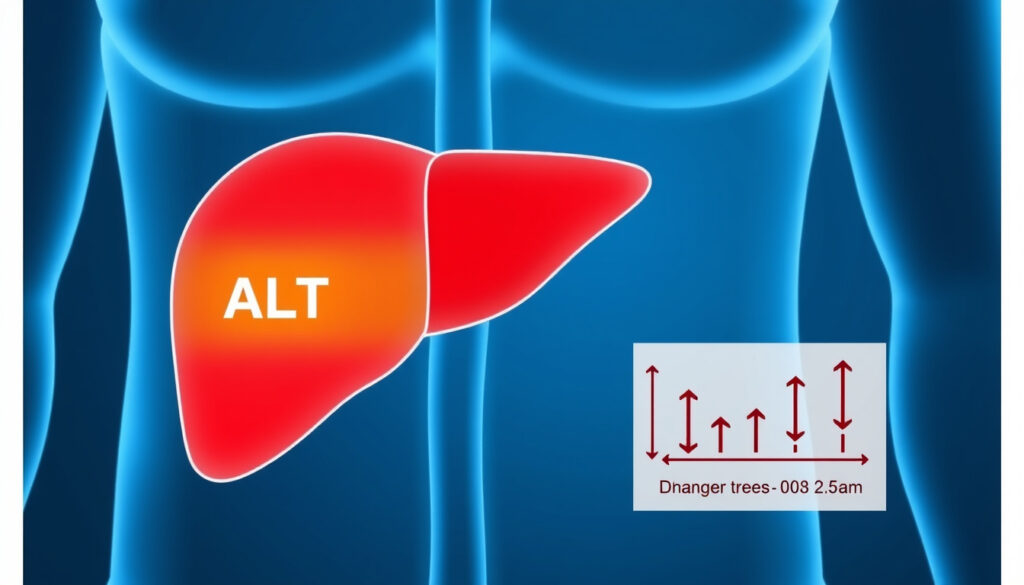
ALT SGPT High: Normal Range, Danger Zone, & How to Lower
Seeing a high ALT SGPT number on your lab report can feel unsettling, but more often than not, it’s a nudge rather than a crisis. This guide walks through what elevated alanine aminotransferase really signals, separates actionable thresholds from unnecessary worry, and lays out the lifestyle changes that evidence says can actually bring your levels down.
Normal ALT range: 7–56 U/L (varies by lab) ·
Prevalence of elevated ALT in US adults: ~20% ·
Most common cause of high ALT: Non-alcoholic fatty liver disease (NAFLD) ·
Estimated US adults with NAFLD: 100 million ·
Typical ALT drop from 5% weight loss: 10–20 U/L
Quick snapshot
- ALT rises when liver cells are damaged (MedlinePlus (US National Library of Medicine))
- Weight loss and alcohol abstinence reduce ALT (Medical News Today (health journalism))
- Normal ranges vary by age, sex, and laboratory (PubMed Central (academic research))
- Optimal “danger zone” threshold — above 100 U/L is common cited but not universal (PubMed Central (guideline review))
- Long-term effects of isolated mild ALT elevations without underlying disease (PubMed Central (guideline review))
- Peak ALT after acute liver injury: 24–48 hours (Cleveland Clinic (hepatology department))
- If ALT remains elevated, a liver etiology screen is recommended (PubMed Central (2017 guideline))
- Focus on modifiable risk factors — weight, diet, alcohol, medications
The following table summarizes the most common reference ranges and key statistics for ALT SGPT.
| Attribute | Value |
|---|---|
| ALT normal range | 7–56 U/L |
| ALT upper limit for men | ~45 U/L |
| ALT upper limit for women | ~34 U/L |
| ALT in children | Lower than adults, varies by age |
| Peak ALT after acute liver injury | 24–48 hours |
| Most common cause of elevated ALT in US | Non-alcoholic fatty liver disease (NAFLD) — affects an estimated 100 million US adults |
What does it mean if ALT SGPT is high?
Elevated ALT indicates liver inflammation or injury — when liver cells are damaged, this enzyme spills into the bloodstream. As the MedlinePlus (US National Library of Medicine) explains, ALT is measured by a simple blood test and is a key marker of liver health.
Common causes of elevated ALT
- Non-alcoholic fatty liver disease (NAFLD) — the leading cause in the US, affecting roughly 100 million adults
- Alcohol use — excessive drinking can cause alcoholic fatty liver and raise ALT (PubMed Central (liver test guideline))
- Viral hepatitis — including hepatitis B and C (Cleveland Clinic (hepatology team))
- Medication effects — statins, acetaminophen overdose, and some antibiotics can raise ALT
- Other conditions — autoimmune liver disease, hemochromatosis, and rarely Wilson’s disease (PubMed Central (common causes list))
Symptoms associated with high ALT
Mild elevations often have no symptoms. As the WebMD (health information provider) notes, ALT is part of a panel — it alone does not diagnose liver disease. When symptoms do appear, they may include fatigue, vague abdominal discomfort, or jaundice in more advanced cases (Hinduja Hospital (clinical education)).
Why it is not a liver function test alone
ALT is one marker among many (AST, ALP, bilirubin, GGT). A raised ALT in isolation, especially a mild one, often resolves on its own or responds to lifestyle changes. The pattern: high ALT with normal other enzymes often points to fatty liver rather than acute hepatitis (Cleveland Clinic (hepatology reference)).
The implication: An isolated ALT rise is rarely an emergency — it’s a prompt to check the broader picture of diet, alcohol, and medications.
What is the danger zone for SGPT?
Reference ranges vary by lab, but clinical guidelines give useful benchmarks for when ALT requires attention.
Understanding ALT reference ranges
The commonly cited normal range is about 7 to 56 U/L, but PubMed Central (population study) notes that upper limits differ substantially by laboratory, sex, and region. The American Academy of Family Physicians (primary care guideline) proposes sex-specific upper limits of 29–33 IU/L for men and 19–25 IU/L for women — tighter than many commercial lab ranges.
Most US labs use a broader normal range (7–56 U/L), which may miss early fatty liver inflammation in younger women. The tighter AAFP threshold catches more cases.
— American Academy of Family Physicians
When ALT levels indicate serious liver damage
- Mild elevation: 1–2 times the upper limit of normal (ULN) — commonly linked to NAFLD, alcohol, or medication
- Moderate elevation: 2–5 times ULN — warrants further investigation; North & East Devon NHS (UK referral guidance) recommends structured evaluation
- Severe elevation: >5 times ULN (above ~250 U/L) — urgent evaluation needed
- Very severe: >1000 U/L — suggests acute liver injury from toxins, viral hepatitis, or ischemia (Cornwall NHS (hepatology referral criteria))
Factors affecting ALT levels
- Sex — men typically have higher baseline ALT (PubMed Central (reference interval study))
- Age — ALT tends to rise with age, though patterns vary (AAFP (age and sex norms))
- BMI — obesity is strongly linked to elevated ALT (Cleveland Clinic (NAFLD link))
- Time of day — ALT may be slightly higher in the afternoon
- Exercise — intense workouts can transiently raise ALT (Healthline (lifestyle factors))
What is the average ALT level by age?
Age and sex reshape what’s considered normal. Four data points, one pattern: younger children, older adults, and women all have different ALT norms.
| Population | Approximate ALT range (U/L) | Source |
|---|---|---|
| Children (1–12 years) | 10–35 | PubMed Central |
| Teenagers (13–18 years) | 10–40 (higher in males) | PubMed Central |
| Adult men (19–65 years) | 10–45 (range varies by lab) | AAFP |
| Adult women (19–65 years) | 7–34 (range varies by lab) | AAFP |
| Elderly (65+ years) | May be slightly higher; some labs use same adult range | PubMed Central |
Gender differences
Women have lower baseline ALT, partly due to hormonal effects and lower muscle mass. The AAFP (primary care guideline) adopts a sex-specific upper limit of 25 U/L for women vs. 33 for men. This matters when screening for NAFLD — a woman with ALT of 35 U/L appears “normal” by some labs but may have significant steatosis.
Using the same normal range for men and women misses roughly 20% of NAFLD cases in women. Always check your lab’s reference range and consider sex-specific norms.
— Cleveland Clinic Hepatology Department
The trade-off: More tailored reference ranges catch more disease but can increase unnecessary testing. The British Columbia guideline advises interpreting ALT in the broader clinical picture rather than any single number (Government of British Columbia (clinical guideline)).
How do I reduce ALT SGPT?
You can lower ALT by addressing the underlying causes — and the most effective levers are lifestyle changes, not supplements.
Lifestyle changes to lower ALT
- Weight loss: Losing 5–10% of body weight can reduce ALT by 10–20 U/L in patients with fatty liver (Medical News Today (evidence review))
- Avoid alcohol: Complete abstinence is recommended; even moderate drinking can elevate ALT (PubMed Central (alcohol-related liver disease))
- Exercise: Regular moderate exercise reduces liver fat independent of weight loss (Healthline (diet and exercise strategies))
- Sleep and stress: Poor sleep and chronic stress may worsen fatty liver; aim for 7–8 hours per night
- Coffee: Three or more cups daily is associated with lower ALT and reduced liver stiffness (Healthline (coffee and ALT))
- Mediterranean diet: Rich in vegetables, whole grains, healthy fats — reduces liver fat more than low-fat diets (Medical News Today (diet and NAFLD))
- Avoid added sugars: Fructose from sugary drinks and processed foods directly promotes liver steatosis (Hinduja Hospital (hospital education))
- Limit processed foods: High sodium and trans fats worsen liver inflammation
Medical treatments for underlying causes
- If NAFLD: No FDA-approved drug; lifestyle modification is the first-line treatment
- If viral hepatitis: Antiviral therapy can reduce ALT (Cleveland Clinic (hepatitis management))
- If medication-induced: Withdrawing the offending drug usually normalizes ALT (PubMed Central (drug-induced liver injury))
- If autoimmune: Immunosuppressants (corticosteroids, azathioprine) prescribed by a gastroenterologist
Why this matters: Most people with elevated ALT have a reversible cause. A targeted lifestyle change can bring levels back to normal within 3–6 months.
What are 5 signs of a fatty liver?
Fatty liver (NAFLD) is often called silent because it usually has no symptoms in early stages. When signs do appear, they are often overlooked.
Fatigue
Persistent low energy is the most common symptom — reported in up to half of people with NAFLD. The mechanism is not fully understood but may involve inflammation disrupting cellular energy production.
Abdominal discomfort
A dull ache or fullness in the upper right side of the abdomen, where the liver sits. Some describe it as a vague pressure rather than sharp pain (Cleveland Clinic (hepatology symptom guide)).
Jaundice
Yellowing of the skin and whites of the eyes — this indicates more advanced liver disease and requires immediate evaluation (WebMD (liver disease signs)).
Swelling in legs or abdomen
Fluid retention (edema in the legs, ascites in the abdomen) signals cirrhosis or significant liver dysfunction — not early fatty liver (Hinduja Hospital (liver disease progression)).
Confusion (late stage)
Hepatic encephalopathy — confusion, drowsiness, personality changes — occurs when the liver cannot filter toxins from the blood. This is a medical emergency and indicates end-stage liver disease (PubMed Central (advanced liver disease review)).
The pattern: Most people with fatty liver have zero symptoms. The five signs listed above appear only after significant liver damage has occurred — which is why checking ALT in a routine blood test is so valuable.
Frequently asked questions
Can stress cause high ALT?
Chronic stress is not a direct cause of elevated ALT, but it may indirectly contribute through poor diet, weight gain, and increased alcohol use. A 2021 study found that perceived stress was associated with fatty liver in some populations, but evidence for a direct stress–ALT link is weak (PubMed Central (lifestyle factors review)).
How long does it take for ALT to return to normal?
With effective intervention — weight loss, alcohol cessation, medication adjustment — ALT can improve within 2–4 weeks and normalize in 2–6 months. The timeline depends on the underlying cause and how aggressively it’s addressed (Medical News Today (lifestyle change timeline)).
Is high ALT a sign of cancer?
Rarely. Liver cancer (hepatocellular carcinoma) can cause elevated ALT, but it is far more likely to be from fatty liver, alcohol, or viral hepatitis. ALT alone is not a cancer marker — imaging (ultrasound, CT) and tumor markers (AFP) are used for screening (WebMD (ALT and cancer)).
What medications cause high ALT?
Statins, acetaminophen (especially >3000 mg/day), certain antibiotics (amoxicillin-clavulanate), NSAIDs (diclofenac, ibuprofen at high doses), and some herbal supplements (kava, comfrey) can raise ALT (PubMed Central (drug-induced liver injury list)). Always consult your doctor before stopping any prescribed medication.
Should I take supplements for high ALT?
Most supplements marketed for “liver detox” have no convincing evidence and some can actually increase ALT. Milk thistle and vitamin E have been studied for NAFLD but with mixed results — vitamin E may help certain biopsy-proven cases but carries safety concerns (Healthline (supplement evidence review)).
Can exercise lower ALT levels?
Yes. Moderate aerobic exercise (150 minutes per week of brisk walking) reduces liver fat and ALT by 10–25% even without weight loss. The effect is strongest when combined with dietary changes (Medical News Today (exercise and ALT)).
Does drinking water flush out ALT?
No. ALT is a liver enzyme released into the blood, not a toxin that can be “flushed out.” Staying hydrated is good for overall health, but it will not lower ALT. The only effective ways are to reduce liver injury and allow liver cells to repair — through lifestyle changes and treating the underlying condition (WebMD (myth vs. fact)).
Related reading: Anatomy of the Body: Organs, Systems & Pain Red Flags · Yeast Infection Symptoms: Signs, Causes & When to See a Doctor
For the US patient with an ALT of 45–60 U/L and a normal-findings ultrasound, the implication is clear: adjust your diet and step up your exercise, or accept that a reversible signal may become a fixed problem in five years.
More related posts
 Continents of the World: 7 Main Ones, Sizes & Facts
 Chick-fil-A Sauce: Recipe, Ingredients, and Where to Buy
 Call Me by Your Name: Plot, Meaning & Key Scenes Explained
 2023 Dodge Charger SRT Hellcat: Pricing, Specs & Theft Prevention
 401k Max Contribution 2025: Limits, Catch-Ups & SECURE 2.0
 Dortmund vs. Monterrey: 2-1 Result, Goals & Club World Cup Recap
 Rachel Nichols Jimmy Butler – Heat Players Reach Breaking Point
 How Old Is Travis Kelce and Taylor Swift – Ages, Birthdays, 69-Day Gap
