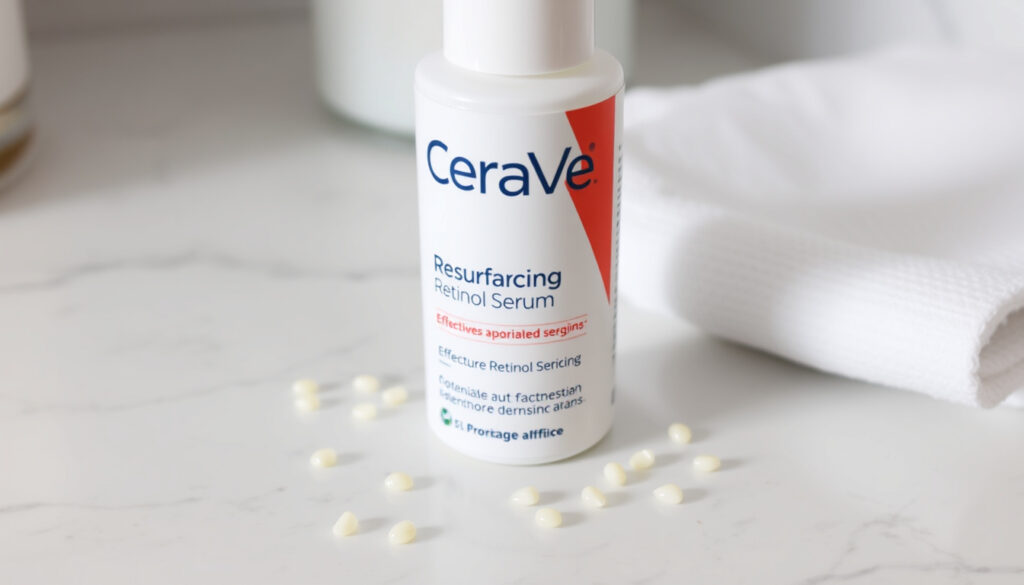
CeraVe Resurfacing Retinol Serum: Does It Work & How to Use
Anyone who’s watched a stubborn dark spot linger for weeks after a breakout knows the frustration. CeraVe Resurfacing Retinol Serum is designed to tackle exactly that kind of post-inflammatory hyperpigmentation, but without the irritation that often steers people away from retinol. Two months of consistent use may be enough to see real fading — here’s what the evidence and testers actually say.
Key ingredients: Retinol, 3 essential ceramides, niacinamide, licorice root extract ·
Skin concerns: Post-acne marks, uneven texture, enlarged pores ·
Formulation type: Lightweight, fragrance-free, non-comedogenic ·
Usage frequency: Start every other night, can progress to nightly if tolerated
Quick snapshot
- Contains retinol, ceramides 1/3/6-II, niacinamide, and licorice root extract (CeraVe official product page)
- Fades post‑acne marks and improves skin texture over weeks of use (Women’s Health beauty editor)
- Fragrance‑free and non‑comedogenic (CeraVe official product page)
- Exact retinol percentage not officially disclosed by the brand (CeraVe product page lists only “encapsulated retinol”)
- Long‑term effects beyond 8 weeks are not documented in available testing (CeraVe product page)
- Efficacy for deep wrinkles or severe hyperpigmentation remains unverified (CeraVe product page)
- Visible brightening and resurfacing results appear within about two months of regular use (Women’s Health 8‑week test)
- Start application two to three times per week, then gradually build to nightly (YouTube skincare educator)
- Always follow with a moisturizer and apply SPF 30+ every morning (Women’s Health usage guidance)
A look at the product’s key specifications shows a formula built for gentle correction.
| Specification | Details |
|---|---|
| Product type | Lightweight serum for evening use |
| Key active ingredients | Retinol, ceramides (1, 3, 6‑II), niacinamide, licorice root extract |
| Skin concerns targeted | Post‑acne marks, uneven skin tone, enlarged pores |
| Paraben and fragrance free | Yes |
| Non‑comedogenic | Yes |
| Size | 30 ml (other sizes available) |
| Retinol delivery system | Encapsulated retinol for gradual release |
| Usage recommendation | Evening application, gradually increase frequency |
| Sun protection required | Yes – SPF 30+ daily |
Does CeraVe Resurfacing Retinol Serum Actually Work?
Beauty writer test results
A Women’s Health beauty editor who tried the serum for eight weeks reported that her “dark spots looked lighter, skin texture felt smoother, and overall complexion looked brighter.” She used a pea‑sized amount mixed with moisturizer three nights a week, then moved to four nights.
A single editorial trial showed objective improvement in hyperpigmentation within two months, but any user should expect slow, cumulative change rather than overnight fading.
Before and after evidence from users
Outside editorial testing, community feedback on YouTube reviews suggests that users with mild to moderate post‑acne marks see reduction after six to eight weeks. The brand itself describes the serum’s function as targeting “the appearance of post‑acne marks,” also called post‑inflammatory hyperpigmentation (CeraVe product page).
Key ingredients that contribute to efficacy
- Encapsulated retinol gently exfoliates and accelerates cell turnover without the harshness of free retinol (CeraVe product page).
- Niacinamide helps even skin tone and supports barrier function (CeraVe product page).
- Licorice root extract is a known brightening agent that targets hyperpigmentation (CeraVe product page).
Bottom line: The serum works, but at a slower pace than high‑concentration retinoids. For first‑time retinol users, the trade‑off is gentleness over speed. For those already tolerant, a stronger formula may produce faster results.
What Does CeraVe Resurfacing Retinol Serum Do?
Targeted benefits: post‑acne marks, texture, pores
The formula specifically addresses three concerns: fading discoloration from old acne spots, smoothing uneven texture, and minimizing the appearance of enlarged pores. According to CeraVe’s official page, the serum is “not a spot treatment” but an overall resurfacing product.
How retinol, ceramides, and niacinamide work together
- Retinol speeds up skin renewal, pushing pigment to the surface.
- Ceramides 1, 3, and 6‑II rebuild the barrier that retinol can weaken.
- Niacinamide calms inflammation and boosts evenness.
This combination is designed to let retinol do its job without stripping the skin. A Women’s Health editor specifically mentioned that she experienced no major irritation, only slight redness when she used more than a pea‑sized amount.
Difference vs other CeraVe retinol products
CeraVe also sells a Skin Renewing Retinol Serum, which targets wrinkles and is formulated for the whole face. The Resurfacing version is lighter and focuses on post‑acne marks. The Resurfacing formula includes licorice root extract, while the Renewing version does not (CeraVe product comparison).
The pattern: one targets aging, the other targets hyperpigmentation. Pick based on your primary concern.
How to Use CeraVe Resurfacing Retinol Serum
Step‑by‑step routine
- Cleanse your face with a gentle, non‑exfoliating cleanser.
- Apply a pea‑sized amount of serum to dry skin evenly, avoiding the eye area.
- Follow with a moisturizer to lock in hydration and buffer potential irritation.
Frequency: start every other night, increase gradually
Begin with two to three times per week, as recommended by YouTube skincare educators and echoed by the brand’s labeling. If no redness or peeling occurs after two weeks, you can move to every other night, then eventually nightly. One Women’s Health tester used it three nights a week initially and never had to scale back.
Important precautions
- SPF 30+ every morning is non‑negotiable – retinol increases sun sensitivity (Women’s Health safety note).
- Avoid combining with other retinol, AHAs/BHAs, or high‑concentration vitamin C in the same routine (YouTube patch testing advice).
- If you experience stinging or peeling, reduce frequency or buffer with moisturizer first.
Over‑applying – using more than a pea‑sized amount – can cause redness even in tolerant skin, as one beauty editor discovered.
The implication: careful application and gradual introduction are essential for success.
Can You Use CeraVe Resurfacing Retinol Serum Every Day?
Expert opinion on daily vs every other night
Once your skin has built tolerance – typically after four to six weeks – daily use is considered safe by the brand and by YouTube skincare educators. However, the majority of users and testers (including Women’s Health) stay at every other night without issue.
Signs you should reduce frequency
- Redness, peeling, or stinging that lasts beyond the first week
- A feeling of tightness or sensitivity
- If you accidentally used more than a pea‑sized amount and see irritation
The Women’s Health tester said the only time she experienced redness was when she applied a larger dose – a clear signal that quantity matters as much as frequency.
CeraVe’s official recommendation
On the product page, CeraVe says to “apply the serum evenly to the face daily” (CeraVe). But dermatologists and beauty editors almost always advise starting slower. The catch: the brand’s published guidance may be too aggressive for sensitive newcomers. Listen to your skin first.
What Should You Never Mix with Retinol?
Ingredients to avoid in the same routine
- Benzoyl peroxide – can oxidize retinol and reduce its effectiveness (YouTube skincare educator warning).
- Strong AHAs/BHAs – over‑exfoliation leading to irritation.
- L‑ascorbic acid (vitamin C) – can cause stinging when used at the same time as retinol. Use vitamin C in the morning, retinol at night.
Safe combinations
- Hyaluronic acid – hydrating and compatible.
- Niacinamide – already in the serum, fine to layer with other niacinamide products.
- Gentle moisturizers – always the final step.
Why mixing reduces efficacy or increases irritation
Retinol works by accelerating cell turnover; combining it with other exfoliants multiplies that effect and can strip the barrier. The Women’s Health tester used only a basic cleanser and moisturizer alongside the serum – a good benchmark for anyone starting out.
The trade‑off: using fewer actives means slower results but far fewer side effects.
Upsides
- Gentle enough for retinol beginners (CeraVe)
- Strengthens skin barrier with ceramides (CeraVe)
- Niacinamide and licorice extract target pigmentation without bleaching (CeraVe)
- Fragrance‑free reduces irritation risk (CeraVe)
Downsides
- Slow visible changes – up to 8 weeks (Women’s Health)
- Exact retinol percentage undisclosed by brand
- May cause purging in some users (YouTube community feedback)
- Not effective for deep wrinkles or severe hyperpigmentation (limited evidence)
The implication: simplicity in routine reduces the risk of irritation and maximizes retinol’s benefits.
Step‑by‑Step Guide to Incorporating the Serum
- Patch test first on a small area behind the ear or jawline (YouTube educator advice).
- Apply on clean, dry skin in the evening. Use a pea‑sized amount (Women’s Health).
- Moisturize immediately after, or mix with moisturizer if skin is sensitive (Women’s Health technique).
- SPF every morning – never skip (Women’s Health mandatory rule).
- Increase frequency only after two weeks of no irritation (CeraVe guidance).
What We Know and What’s Unclear
Confirmed facts
- Contains retinol, ceramides, niacinamide, licorice root extract (CeraVe)
- Fades post‑acne marks over weeks of consistent use (Women’s Health)
- Fragrance‑free and non‑comedogenic (CeraVe)
What remains unclear
- Exact percentage of retinol – not officially disclosed (CeraVe product page mentions only “encapsulated retinol”)
- Long‑term effects beyond 8 weeks of use – no published studies
- Efficacy for deep wrinkles or severe hyperpigmentation – not tested in available sources
“I saw visible brightening and resurfacing results after about two months.”
— Women’s Health beauty editor
“Start with two to three times per week, then build toward nightly as your skin adjusts.”
— YouTube skincare educator
The consequence is straightforward: for anyone struggling with post‑acne marks, this serum offers a gentle entry into retinoid use. The catch is that two months of patience is the minimum before the mirror shows a real difference. For those who need faster fading or target deeper hyperpigmentation, a higher‑strength product may be worth consulting a dermatologist about.
nextbest.one, youtube.com, youtube.com, gopicky.com, glowrecs.com
For those wondering how the formula compares to other retinol options, a detailed review of CeraVe Resurfacing Retinol Serum examines its benefits and step-by-step usage in more depth.
Frequently asked questions
Does CeraVe Resurfacing Retinol Serum help with wrinkles?
The formula is primarily designed for post‑acne marks and uneven texture. While retinol can reduce fine lines over time, this product’s low concentration and focus on hyperpigmentation make it less effective for deep wrinkles than dedicated anti‑aging serums.
Can I use CeraVe Resurfacing Retinol Serum with vitamin C?
Yes, but in separate routines: vitamin C (L‑ascorbic acid) in the morning, retinol at night. Combining them in the same application can cause irritation and reduce potency (skincare educator recommendation).
How long does it take to see results from CeraVe Resurfacing Retinol Serum?
One Women’s Health tester reported visible improvement in about eight weeks. Most users may start noticing a brighter, smoother appearance after four to six weeks of consistent use.
Is CeraVe Resurfacing Retinol Serum safe during pregnancy?
Retinol is generally not recommended during pregnancy. Consult your obstetrician before using any vitamin A derivative skincare product while pregnant or nursing.
Can I use CeraVe Resurfacing Retinol Serum on dark spots?
Yes – the product targets post‑inflammatory hyperpigmentation, which includes dark spots from acne. It is not intended for melasma or sun spots, though some users see improvement (CeraVe).
Does CeraVe Resurfacing Retinol Serum cause purging?
Some users experience a temporary increase in breakouts during the first few weeks as retinol speeds up cell turnover. This is typical and usually subsides (YouTube community reports).
What is the difference between CeraVe Resurfacing Retinol Serum and Skin Renewing Retinol Serum?
The Resurfacing version contains licorice root extract for pigmentation and is lighter in texture. The Skin Renewing version is richer and targets fine lines and wrinkles. Choose based on your primary concern (CeraVe product comparison).
More related posts
 Oklahoma City Thunder vs Denver Nuggets: Score, Stats & Prediction
 Garden of Life Probiotics – 2025 Review and Buyer’s Guide
 Crying in H Mart: Summary, Themes, and Reader Guide (2025)
 FedEx St. Jude Championship 2025: Winner, Purse & Key Facts
 Museum of Science and Industry Chicago: Hours & Tickets
 Best Sushi Near Me: Healthy Options & Safety Tips in Ireland
 USB-C to USB Adapter: Safety, Compatibility, and Common Issues
