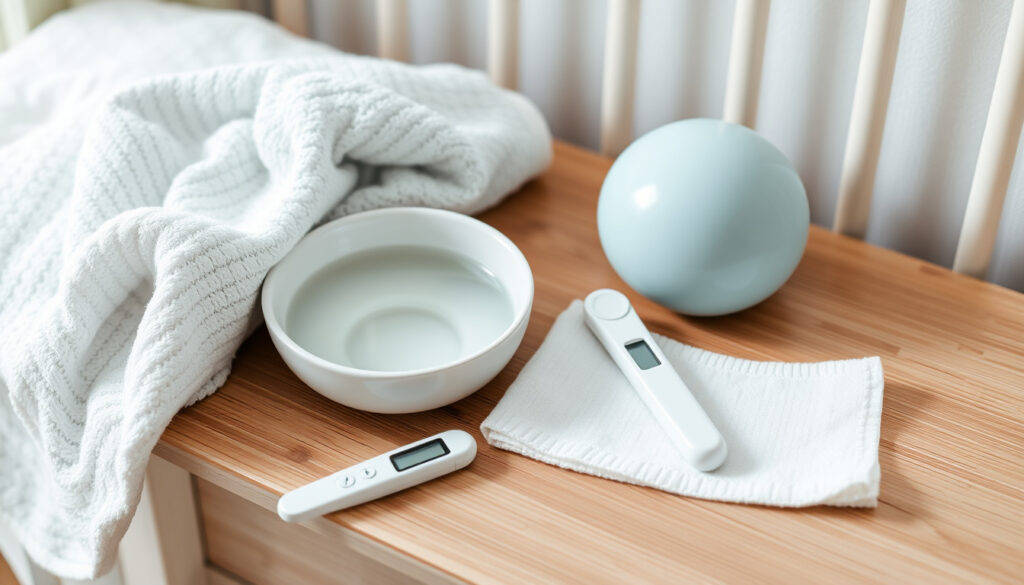
How to Reduce Fever in Baby Naturally: Safe Home Remedies
When your baby’s temperature climbs, the instinct to act fast is overwhelming. Most infant fevers are the body’s way of fighting infection, and safe natural steps can ease discomfort at home.
Normal body temperature range: 97°F to 100.4°F (36°C to 38°C) ·
Fever threshold in infants: Rectal temperature of 100.4°F (38°C) or higher ·
Common cause of fever in babies: Viral infections, teething, post-vaccination ·
When to call a doctor immediately: If baby is under 3 months with any fever, or if fever lasts more than 24 hours in older infants
Quick snapshot
- Lukewarm baths help reduce fever (Nationwide Children’s Hospital)
- Hydration prevents dehydration (TYLENOL pediatric guidance)
- Acetaminophen and ibuprofen are effective fever reducers (HealthyChildren.org (AAP))
- Whether medicating a fever is necessary if the baby is comfortable (St. Louis Children’s Hospital)
- Safety of alcohol sponge baths (HealthyChildren.org (AAP))
- Whether teething alone causes high fever (TYLENOL)
- Fever in infants under 3 months requires immediate medical evaluation; fevers lasting more than 3 days in older infants warrant a doctor visit (HealthyChildren.org (AAP))
- Monitor temperature and be ready to transition to medical care if fever crosses thresholds (HealthyChildren.org (AAP))
- Offer extra fluids (breast milk or formula for infants under 1 year) (St. Louis Children’s Hospital)
| Normal body temperature | 97°F to 100.4°F (36°C to 38°C) |
| Fever threshold (rectal) | ≥100.4°F (38°C) — HealthyChildren.org (AAP) |
| When to call doctor: under 3 months | Any fever — HealthyChildren.org (AAP) |
| When to call doctor: 3-6 months | Fever >101°F (38.3°C) — St. Louis Children’s Hospital |
| When to call doctor: over 6 months | Fever >104°F (40°C) or lasting >3 days — HealthyChildren.org (AAP) |
| Safe fever-reducing medicines | Acetaminophen (after 2 months) / Ibuprofen (after 6 months) — St. Louis Children’s Hospital |
| Medication to avoid | Aspirin (risk of Reye’s syndrome) — HealthyChildren.org (AAP) |
| Teething & fever | Teething may cause slight rise (~100.4°F) but not high fever — TYLENOL |
How can I bring my baby’s fever down fast?
Hydration techniques
- Offer breast milk or formula frequently — for babies under 1 year, these are the primary hydrating fluids (TYLENOL pediatric guidance).
- For older infants over 6 months, small amounts of water, diluted juice, or oral rehydration solutions can be added (St. Louis Children’s Hospital).
- Avoid sugary drinks — they can worsen diarrhea or dehydration.
A feverish baby loses fluids faster. Without extra hydration, dehydration sets in quickly — a danger that often goes unnoticed until the baby becomes lethargic. Keep a feeding log during the first 24 hours.
Lukewarm sponge bath steps
- Fill a basin with lukewarm water (85–90°F / 29–32°C) — never cold or hot (Nationwide Children’s Hospital).
- Sponge your baby’s body gently; avoid the head and face.
- Stop immediately if your baby starts shivering — that can raise internal temperature.
- Limit the bath to 10–15 minutes, then pat dry and dress lightly.
Do not add alcohol to the water — it can be absorbed through the skin and cause poisoning (HealthyChildren.org (AAP)).
Dressing baby in light clothing
- Dress your baby in a single layer of cotton — overdressing traps heat and makes temperature rise further (TYLENOL).
- Keep the room temperature comfortable (68–72°F / 20–22°C).
- For babies under 1 year, use a sleep sack or wearable blanket instead of loose blankets (HealthyChildren.org (AAP)).
The pattern: Fast relief isn’t about quick fixes — it’s about removing physical stressors (dehydration, overheating, shivering triggers) so the baby’s own immune response can work without complications.
Implication: The fastest natural relief comes from hydration, a lukewarm bath, and light clothing. These steps support the body’s immune response without medication.
How to control baby fever at night?
Room temperature and bedding
- Keep the nursery cool but not cold — a temperature around 68°F (20°C) helps the baby regulate naturally (HealthyChildren.org (AAP)).
- Use a single cotton sleeper or sleep sack — remove any extra blankets or stuffed toys.
- Ventilate the room, but avoid direct drafts on the baby.
Monitoring temperature during sleep
- Check your baby’s temperature every 2–4 hours while asleep — a rectal thermometer provides the most accurate reading for infants (St. Louis Children’s Hospital).
- Record each measurement to share with your pediatrician if needed.
Fevers often spike at night, but that doesn’t mean the infection is worsening. The key is to distinguish a manageable rise from a dangerous one — if the temperature crosses 104°F (40°C) at any hour, call your doctor (HealthyChildren.org (AAP)).
When to give fever-reducing medication
- Acetaminophen (e.g., Tylenol) is approved for infants over 2 months; ibuprofen (e.g., Motrin) for those over 6 months (St. Louis Children’s Hospital).
- Give medication only if the baby is uncomfortable — the goal is comfort, not a normal temperature (TYLENOL).
- Never give aspirin to a child with fever — it’s linked to Reye’s syndrome (HealthyChildren.org (AAP)).
The trade-off: Medication can bring down a fever fast, but it may mask symptoms that help you judge severity. At night, when monitoring is harder, some parents prefer to wait unless the baby is clearly distressed. The American Academy of Pediatrics advises that treating the fever itself is less important than keeping the child hydrated and comfortable.
What this means: Nighttime fever care relies on a cool room, regular temperature checks, and medication only when the baby is uncomfortable. Always prioritise hydration and comfort over a normal temperature reading.
What is the 24-hour rule for fever?
Definition of the 24-hour rule
- The “24-hour rule” states that a child should be fever-free for 24 hours without the use of fever-lowering medication before returning to daycare or school (HealthyChildren.org (AAP)).
- This guideline helps ensure the child is no longer contagious and can handle normal activities.
When to return to normal activities
- Once the 24-hour fever-free window closes, the child can resume usual routines — but watch for lingering fatigue or reduced appetite.
Exceptions for infants under 3 months
- For newborns and young infants under 3 months, any fever (even low-grade) requires immediate medical evaluation — the 24-hour rule does not apply (HealthyChildren.org (AAP)).
- Their immature immune systems can’t localize infections, so a fever may be the only sign of a serious bacterial illness.
The catch: The 24-hour rule is a practical tool for schools, but for parents of babies under 3 months, it’s irrelevant — any temperature ≥100.4°F rectal means you call the pediatrician, period.
Implication: For older infants, the 24-hour rule guides return to school; for infants under 3 months, any fever bypasses the rule and requires an immediate call to the doctor.
What should I do if my baby’s head is hot?
How to accurately measure temperature
- Use a rectal thermometer for infants — armpit (axillary) and forehead (temporal) readings are less reliable for clinical decisions (HealthyChildren.org (AAP)).
- Clean the thermometer with soap and water or rubbing alcohol before and after each use.
- Take a reading when the baby is calm — crying can raise skin temperature slightly.
Differentiating head heat from fever
- A hot forehead alone is not a reliable indicator of fever — babies often have warm heads after crying, nursing, or being in a warm room.
- The only way to confirm a fever is by taking a rectal temperature.
When a hot head is not a fever
- If the baby is active, feeding normally, and the rectal temperature is below 100.4°F (38°C), the hot head is likely environmental or due to exertion.
- Overdressing or a warm room can cause head heat without illness — adjust the room temperature and remove a layer, then recheck after 15 minutes.
The implication: Many parents worry unnecessarily over a warm head. A calm, accurate temperature check saves you from false alarms — and also ensures you don’t miss a real fever when it’s masked by pulling blankets off.
How long is too long for a child’s fever?
Duration guidelines by age
- For children over 3 months: a fever lasting more than 3 days warrants a doctor visit (TYLENOL pediatric guidance).
- For babies under 3 months: any fever duration is too long — seek care immediately.
- If the fever goes away and then returns after 24 hours, that’s also a reason to call the pediatrician.
Signs of serious illness
- Seek emergency care if fever is accompanied by difficulty breathing, a rash that doesn’t fade when pressed (HealthyChildren.org (AAP)), lethargy, inconsolable crying, or a seizure.
- A febrile seizure itself is often not dangerous, but it requires immediate medical evaluation to rule out underlying infection.
When to visit the emergency room
- Go to the ER if your baby is under 3 months with any fever, if the temperature reaches 104°F (40°C) or higher, if the child is hard to wake, or if you see signs of dehydration (less than 4 wet diapers in 24 hours).
Why this matters: Fevers are common, but duration is a key diagnostic clue. A fever that drags on for three days may indicate a bacterial infection that needs antibiotics — waiting longer can lead to complications.
Step-by-Step Natural Fever Reduction Plan
- Hydrate first. Offer breast milk or formula every 1-2 hours. For infants over 6 months, small sips of water or oral rehydration solution (St. Louis Children’s Hospital).
- Cool the body gently. Give a lukewarm sponge bath (85–90°F) for 10-15 minutes. Stop if shivering starts (TYLENOL).
- Dress for comfort. Remove heavy clothing and blankets; dress in a single layer of cotton. Keep room at 68-72°F.
- Monitor temperature. Use a rectal thermometer every 4 hours. Record readings for your pediatrician.
- Consider medication only if needed. Acetaminophen (after 2 months) or ibuprofen (after 6 months) if baby is uncomfortable — not just because the number is high (St. Louis Children’s Hospital).
What We Know and What’s Unclear
Confirmed facts
- Lukewarm sponge baths help reduce fever (Nationwide Children’s Hospital)
- Hydration with breast milk/formula prevents dehydration (St. Louis Children’s Hospital)
- Acetaminophen and ibuprofen are effective and safe when dosed correctly (TYLENOL pediatric guidance)
- Alcohol sponge baths are dangerous and should never be used (HealthyChildren.org (AAP))
- Aspirin is contraindicated in children (Reye’s syndrome risk) (HealthyChildren.org (AAP))
What’s unclear
- Herbal remedies (eucalyptus, garlic) lack rigorous safety and efficacy data for infants (St. Louis Children’s Hospital)
- Alcohol sponge baths: not recommended, but some old practices persist — evidence shows absorption risk (HealthyChildren.org (AAP))
- Whether teething alone can cause a high fever — current consensus says no (TYLENOL; ADA (MouthHealthy))
- Optimal timing for alternating acetaminophen and ibuprofen — studies differ (HealthyChildren.org (AAP))
- Whether a baby’s warm head alone is a reliable sign of fever (HealthyChildren.org (AAP))
Expert Perspectives on Managing Baby Fevers
“Babies under 3 months with a temperature of 100.4°F (38.0°C) or higher need urgent medical evaluation.”
— American Academy of Pediatrics, via HealthyChildren.org
“A child with fever who looks or acts very sick should be evaluated by a doctor. Hydration is key — extra fluids reduce the risk of dehydration.”
— Nationwide Children’s Hospital
“Fever that reaches 104°F (40°C) is a doctor-call threshold in pediatric guidance.”
— American Academy of Pediatrics, via HealthyChildren.org
The Bottom Line
For parents of infants, the choice is clear: most fevers are manageable at home with simple natural methods — hydration, light clothing, and lukewarm baths — as long as you know the boundaries. For a baby under 3 months, any fever is a medical call, not a home-care situation. For older infants, watch the clock and the thermometer: if the fever crosses 104°F or lasts beyond three days, it’s time to talk to your pediatrician. The safest path is preparation — keep a rectal thermometer on hand, know your baby’s baseline, and have a conversation with your doctor before you need one in the middle of the night.
pediakid.com, tylenol.com, cdc.gov, mysanitas.com, blueberrypediatrics.com, doctorondemand.com
Frequently Asked Questions
Can teething cause a fever?
Teething may cause a slight rise in temperature (around 100.4°F / 38°C) but not a true high fever. If your baby has a fever above that, or if it’s accompanied by diarrhea or rash, consult your pediatrician — it’s likely not teething (TYLENOL; ADA (MouthHealthy)).
Is it safe to give my baby a bath during a fever?
Yes, a lukewarm sponge bath (not cold) can help bring down temperature. Avoid cold water or alcohol in the water. Stop if the baby shivers (Nationwide Children’s Hospital).
What temperature is too high for a baby?
For babies under 3 months, any temperature ≥100.4°F (38°C) rectal requires immediate medical attention. For older infants, a temperature of 104°F (40°C) or higher is a call-to-doctor threshold (HealthyChildren.org (AAP)).
How often should I check my baby’s temperature?
During a fever, check every 2–4 hours, especially overnight. Use a rectal thermometer for the most accurate reading (St. Louis Children’s Hospital).
Can I use fever-reducing medicine and natural remedies together?
Yes, they can complement each other. Natural methods like lukewarm baths and light clothing work well alongside medication. Just be sure to follow age-appropriate dosing for medicines and never exceed the recommended dose (Nationwide Children’s Hospital).
Should I wake my baby to give medicine?
If the baby is sleeping comfortably and not in distress, it’s generally fine to let them sleep. Waking a sleeping child to give medication is not necessary unless the fever is very high (≥104°F) or your doctor advised otherwise (HealthyChildren.org (AAP)).
What is the best thermometer for infants?
A digital rectal thermometer is the gold standard for infants under 1 year. Temporal (forehead) and ear thermometers are less accurate for this age group (HealthyChildren.org (AAP)).
Related Reading
More related posts
 When Is Hurricane Season in Florida – Official Dates and Peak Months
 AC Replacement Near Me: Cost, Health & 3-Minute Rule
 2023 Dodge Charger SRT Hellcat: Pricing, Specs & Theft Prevention
 Folate vs Folic Acid: Differences, Sources, and Pregnancy Use
 How Much Fiber Per Day? Daily Intake Guide
 How to Set Up Google Alerts: iPhone, Android & Web
 Anatomy of the Body: Organs, Systems & Pain Red Flags
