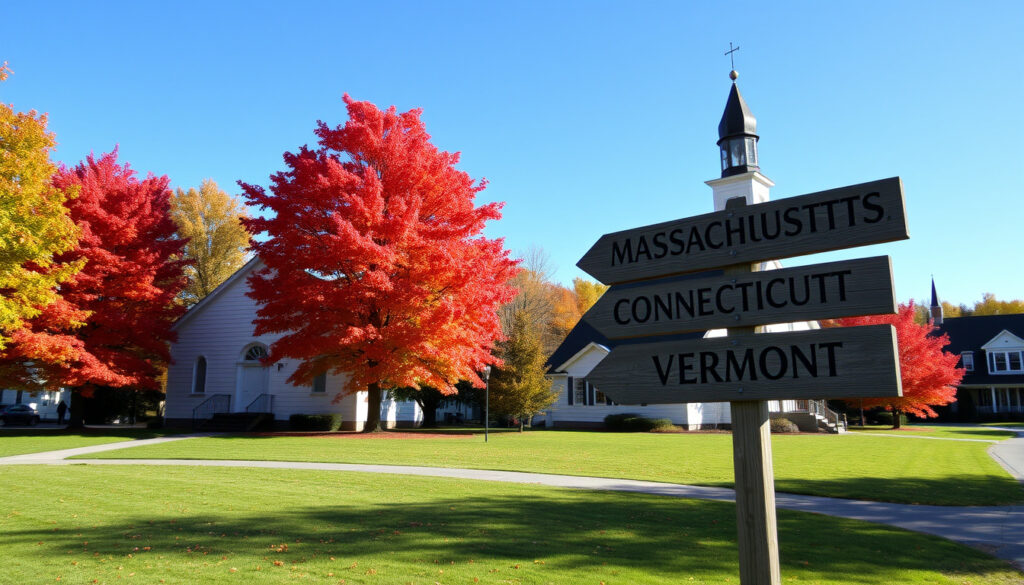
Where is New England? States, Map, and History Explained
Chances are you’ve heard the name “New England” — maybe from a history book, a football game, or that friend who moved to Boston after college. But where exactly is New England, and what defines it as a region? This guide lays out the six states, the story behind the name, and a few misconceptions that often trip people up, like whether New York is included (it isn’t).
Number of states: 6 · Total area: 78,177 sq mi (202,500 km²) · Largest city: Boston, Massachusetts · Population (2023 estimate): 14.9 million · First European settlement: Plymouth, 1620 · Highest point: Mount Washington, New Hampshire (6,288 ft)
Quick snapshot
- Six states: Connecticut, Maine, Massachusetts, New Hampshire, Rhode Island, Vermont (Wikipedia)
- Located in the Northeastern United States (Britannica)
- Exact origin of the term “Yankee” — theories derive from Dutch “Janke” or Native American adaptations
- 1614–1616: Capt. John Smith names the region (Britannica)
- 1620: Plymouth Colony established (Wikipedia)
- New England continues as a major tourism destination and cultural hub, with fall foliage and coastal attractions drawing millions yearly
Of the six states that make up the region, the variance in size is striking — one state alone accounts for nearly half the land area.
| Capital city (de facto) | Boston, Massachusetts |
| Number of states | 6 |
| Highest point | Mount Washington, New Hampshire (6,288 ft / 1,917 m) |
| Major nicknames | Yankee, New Englander |
| Primary language | English (with distinct New England dialect) |
Which states make up New England?
New England is a region in the northeastern corner of the United States, not a single state. It consists of exactly six states: Connecticut, Maine, Massachusetts, New Hampshire, Rhode Island, and Vermont (Wikipedia). The region is bordered by New York to the west, the Canadian provinces of New Brunswick and Quebec to the north, the Atlantic Ocean and Gulf of Maine to the east and southeast, and Long Island Sound to the southwest (Wikipedia).
What are the six New England states?
- Connecticut — area 5,543 sq mi
- Maine — area 35,380 sq mi, nearly half of all New England (Wikipedia)
- Massachusetts — area 10,554 sq mi (Wikipedia)
- New Hampshire — area 9,349 sq mi
- Rhode Island — area 1,545 sq mi
- Vermont — area 9,616 sq mi (Wikipedia)
To put that scale in perspective: Maine at 35,380 square miles (including water) is slightly smaller than Indiana, and the total region of 71,988 square miles (including water) is slightly larger than Washington state but slightly smaller than Great Britain (Wikipedia).
The takeaway: Maine dominates the region’s geography, covering nearly half its land area, while the six states together form a compact territory roughly the size of Great Britain.
Is New England a region?
Yes — New England is a geographic and cultural region, not a political state. It has no single capital, though Boston serves as the de facto hub for economics, education, and sports. The region shares a common colonial history, a distinct dialect, and strong regional identity that sets it apart from the rest of the Northeast (Britannica).
The six states are distinct, but what makes them New England isn’t geography alone — it’s the shared origin story of Puritan settlements, Revolutionary War battles, and a culture that proudly uses “wicked” as an adverb.
Why is it called New England?
The name dates back to 1616, when English explorer and colonist Captain John Smith published “A Description of New England” after mapping the coastline from Maine to Cape Cod for London merchants (Britannica). Smith personally christened the region “New England,” and the name stuck.
Who named New England?
Captain John Smith, best known for his role in the Jamestown colony, made two voyages to the Northeast coast in 1614 and 1615. He produced a detailed map and report that caught the attention of the English crown. In 1620, the Plymouth Council for New England was chartered, officially adopting the name for the territory (Wikipedia).
Why do we still call it New England?
The name persisted through the colonial era, the American Revolution, and statehood because it became the region’s unifying identifier — a label that predates the United States itself. Unlike other colonial names that faded (New Netherland, New France), New England anchored a set of distinct colonies that later became the six states we know today (Britannica).
What this means: Smith’s branding in 1616 gave the region an identity that survived independence, outlasting the colonial labels that other American territories dropped.
New England’s name is a direct link to the English colonial project. Without Smith’s branding in 1616, the region might have been called “North Virginia” or something else entirely — and tens of thousands of football fans would be cheering for the “North Virginia Patriots.”
What are people from New England called?
The simple answer is “New Englanders.” For a more colorful term, there’s “Yankee.” Historically, Yankee referred specifically to New Englanders of old-stock British ancestry — the rural farmers and shipbuilders of the region. Outside the U.S., “Yankee” (or “Yank”) often means any American, but within the country, the term is still tied most closely to New England (Wikipedia).
What is a Yankee?
The origin of “Yankee” is one of the few genuinely unsettled questions about New England. Theories include a Dutch derivation from “Janke” (a diminutive of John), or a Native American pronunciation of “English.” No single origin has been proven, which is why it sits in the “what’s unclear” column. What is clear is that the word became a nickname for New Englanders by the mid-1700s and later a broader American identifier.
The catch: While “Yankee” now describes any American abroad, its roots are firmly planted in New England — a label whose exact origin remains stubbornly unclear.
What is the largest city in New England?
Boston, Massachusetts, is the largest city in New England, with a metro population of roughly 4.9 million. It is also the region’s economic and cultural capital — home to Harvard and MIT, the Freedom Trail, and the Boston Red Sox (Britannica).
What is the main city of New England?
Boston is the undisputed main urban center. It was founded in 1630 as the capital of the Massachusetts Bay Colony and quickly became the region’s largest port and seat of government. Today it hosts the region’s largest airport (Logan International) and its busiest transit hub.
Is Boston in New England?
Yes — Boston is in Massachusetts, one of the six New England states. There is no debate: if you’re in Boston, you’re in New England. This is one of the most common questions because people often conflate Boston with the whole region, but the city is squarely within its boundaries.
Where is the New England Patriots stadium?
Gillette Stadium, home of the New England Patriots, is located in Foxborough, Massachusetts — about 22 miles southwest of downtown Boston. It opened in 2002 and also hosts the New England Revolution soccer team (Wikipedia).
Why is it New England Patriots and not Boston?
When the team was founded in 1959 as a charter member of the American Football League, the owners chose “New England Patriots” to represent the entire six-state region, not just a single city. The strategy worked: the Patriots have fan bases stretching from Connecticut to Maine, making the regional name more inclusive and marketable (Wikipedia).
Where is New England Patriots located?
The team’s home stadium is at 1 Patriot Place, Foxborough, MA 02035. The practice facility and team headquarters are in the same complex. The stadium is easily reachable from Boston via I-95 and I-495.
Why is New England so Irish?
New England has one of the highest concentrations of Irish-American residents in the United States. The reason is rooted in a specific historical event: the Great Famine (1845–1852). Over a million Irish fled the famine, and many found their way to New England’s booming industrial cities, especially Boston, Providence, and Lowell (Britannica).
How did Irish immigrants come to New England?
Irish immigrants arrived by ship in Boston and other ports, then took jobs building canals, railroads, and working in textile mills. The wave was so large that by 1850, Boston’s Irish-born population made up 26% of the city (Wikipedia). This legacy remains visible today in Boston’s South Boston neighborhood, the St. Patrick’s Day parade, and the fact that Massachusetts is the most Irish state by percentage (20.2% of residents claim Irish ancestry).
The implication: The famine drove a demographic shift that permanently reshaped New England’s identity, making Massachusetts the most Irish state in the union by ancestry percentage.
The Irish immigration story is often romanticized in tourism campaigns, but the reality was harsh: Irish workers faced discrimination, poverty, and “No Irish Need Apply” signs for generations. That history is just as much a part of New England’s identity as the clam chowder and the Patriots.
Timeline signal
| Date | Event |
|---|---|
| 1614–1616 | Captain John Smith explores and maps the coast, naming it “New England” (Britannica) |
| 1620 | Plymouth Colony established – first permanent European settlement in New England (Wikipedia) |
| 1630 | Massachusetts Bay Colony founded; Boston becomes its center (Britannica) |
| 1775–1783 | American Revolution; New England colonies play a central role (Wikipedia) |
| 1845–1855 | Great Famine triggers massive Irish immigration to New England (Britannica) |
| 1959 | New England Patriots founded as a charter member of the American Football League (Wikipedia) |
Clarity: what we know for sure
Confirmed facts
- New England contains six states: Connecticut, Maine, Massachusetts, New Hampshire, Rhode Island, Vermont (Wikipedia)
- The name “New England” was given by Captain John Smith in 1616 (Britannica)
- Boston is the largest city in New England (Britannica)
- Gillette Stadium (Foxborough, MA) is home to the New England Patriots (Wikipedia)
What’s still unclear
- Exact origin of the term “Yankee” is disputed; theories derive from Dutch “Janke” or Native American adaptations
“Captain John Smith named the region New England after exploring its shores in 1614 for London merchants.”
Britannica (reliable encyclopedia)
“New England is a region comprising six states in the Northeastern United States: Connecticut, Maine, Massachusetts, New Hampshire, Rhode Island, and Vermont.”
Wikipedia (community-edited reference)
What does all this mean for someone trying to understand New England? The region is compact — about the size of Great Britain — yet it packs an outsized influence on American history, language, sports, and politics. For the traveler, the six states offer everything from Maine’s rocky coast to Vermont’s ski slopes. For the historian, New England is the birthplace of the American Revolution. And for the football fan, it’s the home of the six-time Super Bowl champion Patriots.
study.com, oshermaps.org, masshist.org, discovernewengland.org
For a more in-depth look at each state’s geography and history, check out this detailed guide to New Englands states.
Frequently asked questions
Is New York considered part of New England?
No. New York is a separate state and is not included in the New England region. New England shares a western border with New York (Wikipedia).
What is the smallest state in New England?
Rhode Island is the smallest, with an area of 1,545 square miles (Wikipedia).
What is New England known for?
Historic sites (Plymouth Rock, Freedom Trail), fall foliage, seafood (clam chowder, lobster rolls), elite universities (Harvard, MIT), and professional sports teams (Patriots, Red Sox, Celtics, Bruins).
Is New England a good place to visit?
Yes — it appeals to history buffs, outdoor enthusiasts, and food lovers. Peak seasons are autumn (foliage) and summer (coastal towns). (Britannica).
What food is New England famous for?
New England clam chowder, lobster rolls, baked beans, maple syrup, and apple cider donuts. The region’s cuisine is heavily influenced by its coastal geography and colonial heritage.
More related posts
 F1 Film – Brad Pitt Stars in Movie Shot at Real GPs
 Hyatt Regency Grand Cypress: Pool, Shuttle & Disney Views
 Voting Rights Act of 1965: Definition, Impact, and Importance
 Kim Jong Il: Biography, Death, English, LGBTQ Rights & More
 Best Streaming TV Service 2024: Top Picks for Live & On-Demand
 Be t Free Engli h to Spani h Tran lator: Top Tool Compared
 What Can Cats Eat? Safe Human Foods List
 How to Find, Change & Reset Whirlpool Refrigerator Water Filter
