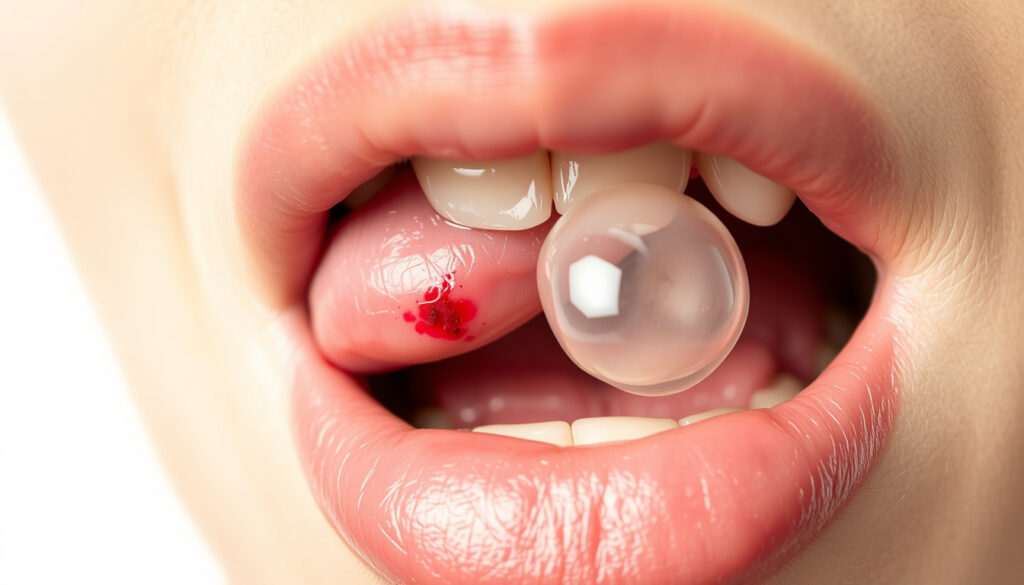
Cold Sore Inside Mouth vs. Canker Sore: Causes & Treatment
You feel a tingle or small bump inside your mouth — is it a cold sore? The answer depends on location and cause, as cold sores and canker sores require different treatments.
Prevalence of HSV-1 in adults (global): 67% of people under 50 ·
Typical cold sore duration: 7–10 days ·
Cold sores vs. canker sores (location): Cold sores: outside mouth; canker sores: inside mouth ·
Annual recurrence rate (HSV-1): Up to 40% of infected individuals
Quick snapshot
- Cold sores are caused by herpes simplex virus type 1 (HSV-1) (Herpes New Zealand (patient advocacy))
- Canker sores are non-contagious; cold sores are contagious (Northwestern Medicine (academic medical center))
- Cold sores typically heal in 7–10 days (Healthline (health publisher))
- Antiviral treatment is most effective when started within 24 hours of symptom onset (Journal of Clinical and Aesthetic Dermatology (peer-reviewed journal))
- Precise triggers for recurrent outbreaks vary by individual (National Institute of Dental and Craniofacial Research (U.S. government research institute))
- The long-term effectiveness of home remedies (e.g., honey) lacks robust clinical evidence (National Institute of Dental and Craniofacial Research (U.S. government research institute))
- Cold sores progress through tingling, blister, ulcer, and crust stages over 7–10 days (Healthline (health publisher))
- Canker sores usually resolve within 7–14 days (Cleveland Clinic (academic medical center))
- Any oral ulcer lasting more than 10–14 days should be evaluated by a dentist or clinician (Mid-Atlantic Society of Oral and Maxillofacial Pathology (professional medical society))
The differences are clear when compared side by side.
| Attribute | Cold Sore (Herpes Labialis) | Canker Sore (Aphthous Ulcer) |
|---|---|---|
| Cause | Herpes simplex virus (HSV-1) (Herpes New Zealand (patient advocacy)) | Not viral; cause unknown but linked to stress, injury, or immune response (National Institute of Dental and Craniofacial Research (U.S. government research institute)) |
| Typical location | Lips, around mouth, gums, hard palate (Northwestern Medicine (academic medical center)) | Inside mouth on cheeks, tongue, soft palate (Northwestern Medicine (academic medical center)) |
| Appearance | Small, fluid-filled blisters that crust over (Northwestern Medicine (academic medical center)) | Shallow yellow/white ulcer with red border (Northwestern Medicine (academic medical center)) |
| Contagious | Yes, until fully healed (Northwestern Medicine (academic medical center)) | No (Northwestern Medicine (academic medical center)) |
| Treatment | Antiviral creams (e.g., docosanol) or oral antivirals (e.g., acyclovir) (U.S. Pharmacist (clinical pharmacy journal)) | Topical anesthetics (benzocaine, lidocaine), mouth rinses (Orajel (oral care brand)) |
| Healing time | 7–10 days (Healthline (health publisher)) | 7–14 days (Cleveland Clinic (academic medical center)) |
Can you get a cold sore just inside your mouth?
Typical cold sore location versus canker sore location
- Cold sores are rare inside the mouth on keratinized tissue (gums, hard palate) (Northwestern Medicine (academic medical center))
- Canker sores appear exclusively inside the mouth on non-keratinized tissue (cheeks, tongue, soft palate) (Northwestern Medicine (academic medical center))
- Oral herpes inside the mouth is usually on the gums or roof of the mouth, not the cheeks or tongue (Herpes New Zealand (patient advocacy))
What herpes simplex virus (HSV-1) blisters look like
- Cold sores are often described as clustered blisters rather than isolated ulcers (Northwestern Medicine (academic medical center))
- Oral herpes can cause blisters or sores on the lips, mouth, and gums (Herpes New Zealand (patient advocacy))
If you feel a sore on the soft tissue of your cheek or tongue, it’s almost certainly a canker sore — not a cold sore. Cold sores inside the mouth are limited to the gums and hard palate, and they appear as clusters of tiny blisters, not single ulcers.
The pattern: Location is the primary diagnostic clue — cold sores rarely appear on soft tissue inside the mouth.
Is it a canker sore or a cold sore?
Appearance differences: blister vs. ulcer
- Cold sores are fluid-filled blisters that crust over; canker sores are shallow yellow/white ulcers with red border (Northwestern Medicine (academic medical center))
- Cold sores typically heal in 7–10 days; canker sores in 7–14 days (Healthline (health publisher))
- Cold sores are caused by HSV-1; canker sores are not viral (Herpes New Zealand (patient advocacy))
Pain type and healing timeline
- Cold sores often begin with a tingling or burning sensation before blisters appear (Healthline (health publisher))
- Canker sores typically cause a sharp, localized pain that worsens with eating or talking (Cleveland Clinic (academic medical center))
The distinction matters for treatment: applying an antiviral cream to a canker sore won’t help, and using a numbing gel on a cold sore won’t stop the virus from spreading. Getting the diagnosis right saves time and discomfort.
The implication: Misidentification can delay effective treatment, so knowing the signs matters.
What causes cold sores inside the mouth?
HSV-1 transmission and primary infection
- HSV-1 is transmitted via oral contact with infected saliva or lesions (Herpes New Zealand (patient advocacy))
- Primary infection often occurs in childhood with no symptoms (National Institute of Dental and Craniofacial Research (U.S. government research institute))
Reactivation triggers: stress, illness, sun, fatigue
- Reactivation occurs due to triggers like fever, stress, UV exposure, or trauma (National Institute of Dental and Craniofacial Research (U.S. government research institute))
- Recurrence frequency varies by individual immune status and triggers (Healthline (health publisher))
What this means: Triggers vary, but awareness can help prevent outbreaks.
How do you treat internal mouth sores?
Over-the-counter antiviral creams (e.g., docosanol)
- Docosanol (Abreva) is an OTC antiviral cream used at the first sign of symptoms for cold sores (GoodRx (health information platform))
- Penciclovir 1% cream is recommended in nonimmunocompromised individuals and should be applied during the prodromal stage (U.S. Pharmacist (clinical pharmacy journal))
Prescription antivirals (acyclovir, valacyclovir)
- Acyclovir is among the antiviral options discussed for oral herpes management (U.S. Pharmacist (clinical pharmacy journal))
- Oral antiviral treatment taken early, before the lesion appears, may reduce symptom duration and healing time in recurrent HSV-1 episodes (Journal of Clinical and Aesthetic Dermatology (peer-reviewed journal))
Home remedies and pain relief
- Pain relief for facial herpes may include paracetamol or ibuprofen, along with cool compresses and keeping the area clean and dry (Herpes New Zealand (patient advocacy))
- Canker sores can be managed with OTC gels that numb pain, and avoiding spicy or abrasive foods may help (National Institute of Dental and Craniofacial Research (U.S. government research institute))
- Canker sores may be treated with mouth rinses or topical anesthetics such as benzocaine or lidocaine (Orajel (oral care brand))
The catch: Antiviral treatment must start early, while home remedies only manage symptoms.
How long will a cold sore last inside the mouth?
Stages of a cold sore outbreak
- Cold sores progress through tingling, blister, ulcer, and crust stages (Healthline (health publisher))
- Healing typically takes 7–10 days without treatment (Healthline (health publisher))
Factors affecting healing time
- Recurrence frequency varies by individual immune status and triggers (National Institute of Dental and Craniofacial Research (U.S. government research institute))
- Antiviral treatment started within 24 hours can shorten outbreak duration by 1–2 days (Journal of Clinical and Aesthetic Dermatology (peer-reviewed journal))
The pattern: Healing time is consistent but can be shortened with early antiviral use.
Are cold sores an STD?
HSV-1 vs. HSV-2 transmission routes
- Cold sores (HSV-1) are primarily oral, not genital, but can spread to genitals via oral sex (Herpes New Zealand (patient advocacy))
- HSV-2 is the main cause of genital herpes (Herpes New Zealand (patient advocacy))
Social and medical classification
- WHO classifies oral herpes as a common viral infection, not an STD, though it can be sexually transmitted (Herpes New Zealand (patient advocacy))
The stigma around cold sores often causes unnecessary anxiety. While HSV-1 can be transmitted sexually, it is not classified as an STD in the same way as HSV-2. For most people, a cold sore is a recurring nuisance, not a marker of sexual health status.
The implication: Social stigma does not change the medical classification — oral herpes is common and manageable.
Confirmed facts vs. what remains unclear
Confirmed facts
- Cold sores are caused by HSV-1 (Herpes New Zealand (patient advocacy))
- Cold sores are contagious through direct contact with the blister or saliva (Northwestern Medicine (academic medical center))
- Antiviral medication reduces outbreak duration when started early (Journal of Clinical and Aesthetic Dermatology (peer-reviewed journal))
What’s unclear
- Precise triggers for recurrent outbreaks vary by individual (National Institute of Dental and Craniofacial Research (U.S. government research institute))
- The long-term effectiveness of home remedies (e.g., honey) lacks robust clinical evidence
“Canker sores always appear inside the mouth, while cold sores usually appear on the lips or around the mouth.”
— Northwestern Medicine (academic medical center)
“A general rule of thumb is that any ulcer lasting more than 10 to 14 days should be evaluated by a dentist or clinician.”
— Mid-Atlantic Society of Oral and Maxillofacial Pathology (professional medical society)
The distinction between a cold sore inside the mouth and a canker sore is not just academic — it determines whether you need antiviral medication or simple pain relief. For the millions of people who carry HSV-1, the key takeaway is location: if it’s on your gums or hard palate and looks like a cluster of tiny blisters, it’s likely a cold sore. If it’s on your cheek or tongue and looks like a shallow white ulcer, it’s a canker sore. For anyone dealing with a sore that persists beyond two weeks, the choice is clear: see a dentist or clinician for an accurate diagnosis, or risk treating the wrong condition.
Frequently asked questions
Can stress cause a cold sore inside my mouth?
Yes, stress is a well-documented trigger for HSV-1 reactivation. When your immune system is under strain from stress, the virus can reactivate and cause a cold sore outbreak (National Institute of Dental and Craniofacial Research (U.S. government research institute)).
What are my first symptoms before a cold sore appears inside my mouth?
The first sign is often a tingling, itching, or burning sensation at the site where the blister will appear. This prodromal stage typically occurs 6–24 hours before visible blisters form (Healthline (health publisher)).
Is a cold sore inside my mouth painful?
Yes, cold sores can be painful, especially during the blister and ulcer stages. The pain is often described as a burning or throbbing sensation. Canker sores, by contrast, typically cause a sharper, more localized pain that worsens with eating or talking (Cleveland Clinic (academic medical center)).
Can I spread the cold sore to other parts of my body?
Yes, you can spread HSV-1 to other parts of your body through direct contact with the blister fluid. This is called autoinoculation. Avoid touching the sore and wash your hands thoroughly after any contact (Herpes New Zealand (patient advocacy)).
When should I see a doctor for a cold sore inside my mouth?
You should see a doctor if the sore lasts more than 10–14 days, if you have frequent recurrences (more than 6 per year), if the pain is severe, or if you have a weakened immune system (Mid-Atlantic Society of Oral and Maxillofacial Pathology (professional medical society)).
Can a cold sore inside my mouth be a sign of something serious?
In most cases, cold sores are a common and benign viral infection. However, in people with weakened immune systems (e.g., from HIV, chemotherapy, or organ transplantation), HSV-1 can cause more severe complications. If you have a compromised immune system and develop a cold sore, consult your doctor promptly (National Institute of Dental and Craniofacial Research (U.S. government research institute)).
Are children more susceptible to inside-the-mouth cold sores?
Children can experience primary HSV-1 infection, which may cause gingivostomatitis — a condition involving sores inside the mouth, on the gums, and on the tongue. This is more common in children aged 6 months to 5 years and can be more severe than recurrent outbreaks in adults (National Institute of Dental and Craniofacial Research (U.S. government research institute)).
More related posts
 Jake T. Austin: Career, Controversies, Age & News
 Carolina Panthers vs Jacksonville Jaguars Player Stats Sep 2025
 Alien: Earth TV Series Cast – Full List of Actors and Their Roles
 Best Dry White Wine for Cooking: 5 Top Picks & Substitutes
 But I’m a Cheerleader: Guide to the Queer Cult Classic
 Trader Joe’s Tote Bag: Price, Resale Frenzy & Boycott
 Cast of Hairspray 2007 – Main Actors and Roles
 Love Is Blind Season 4 Cast: Where Are They Now? (2025 Update)
