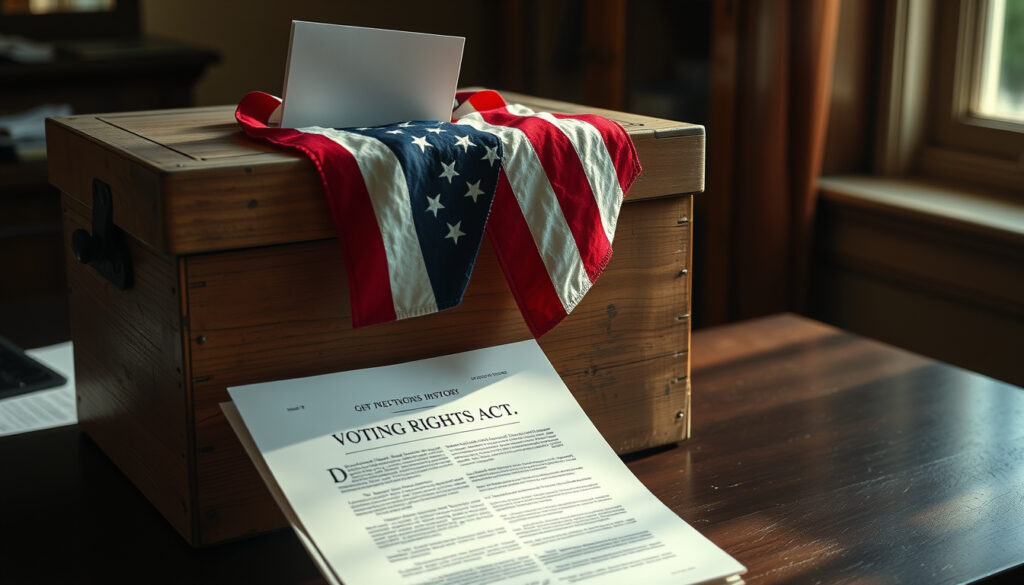
Voting Rights Act of 1965: Definition, Impact, and Importance
If you’ve ever stood in a long line to vote or heard someone talk about “preclearance,” you’ve touched the legacy of the Voting Rights Act of 1965. This law didn’t just outlaw racial discrimination at the polls — it created a federal backstop that transformed American democracy. But over the past decade, Supreme Court rulings have hollowed out its strongest enforcement tools, leaving a patchwork of protections that Congress is still trying to rebuild.
Year Enacted: 1965 ·
Signed by President: Lyndon B. Johnson ·
Senate Vote: 77–19 ·
House Vote: 333–85 ·
Key Provision Struck Down: Section 5 preclearance (Shelby County v. Holder, 2013) ·
Number of Amendments: 5 (1970, 1975, 1982, 1992, 2006)
Quick snapshot
- Landmark federal law signed in 1965 (National Archives (U.S. government archive))
- Outlaws racial discrimination in voting (National Archives (U.S. government archive))
- Enforces the 15th Amendment (Albany Law School Government Law Center)
- Jim Crow barriers (poll taxes, literacy tests, intimidation) (Carnegie Corporation (philanthropic research organization))
- Selma marches and Bloody Sunday galvanized the nation (Carnegie Corporation (philanthropic research organization))
- Earlier civil rights laws failed to secure voting access (National Archives)
- Section 2: nationwide ban on discriminatory practices (National Archives)
- Section 4: coverage formula for preclearance (Rock the Vote (youth civic engagement organization))
- Section 5: federal preclearance for covered jurisdictions (Brennan Center for Justice (nonpartisan law & policy institute))
- Preclearance formula struck down in 2013 (Shelby County) (Carnegie Corporation)
- Section 2 remains active but weakened by later rulings (Brennan Center for Justice)
- Ongoing legislative efforts (John Lewis Voting Rights Act) (Brennan Center for Justice)
The table below consolidates the essential facts about the Voting Rights Act’s enactment and its critical enforcement tool.
| Attribute | Detail |
|---|---|
| Enacted | August 6, 1965 |
| Signed by | President Lyndon B. Johnson |
| Senate Vote | 77–19 |
| House Vote | 333–85 |
| Key Enforcement Tool | Section 5 preclearance (invalidated 2013) |
| Landmark Supreme Court Case | Shelby County v. Holder (2013) |
What is a simple definition of the Voting Rights Act of 1965?
The Voting Rights Act of 1965 is a federal law that prohibits racial discrimination in voting. It was enacted to enforce the Fifteenth Amendment (Albany Law School Government Law Center), which had been largely ignored since its ratification in 1870.
Core purpose of the Act
- Outlaw literacy tests and other discriminatory voting practices (National Archives)
- Require jurisdictions with a history of discrimination to get federal approval before changing election laws
- Provide federal oversight of elections in covered areas
Why it was needed
Despite the Fifteenth Amendment, Southern states had long used poll taxes, literacy tests, and violence to disenfranchise Black citizens. The Civil Rights Act of 1964 did not directly target voting barriers (Carnegie Corporation of New York). By 1965, just 7% of Black adults in Mississippi were registered to vote.
The catch: Without a strong enforcement mechanism, the promise of the 15th Amendment remained hollow. The VRA finally gave that promise teeth.
What did the Voting Rights Act of 1965 do?
The Act created a three-part architecture: a nationwide ban on discrimination (Section 2), a formula to identify the worst offenders (Section 4), and a preclearance requirement that forced those jurisdictions to prove any voting change was not discriminatory (Section 5) (Brennan Center for Justice).
Key provisions: Section 2, Section 4, Section 5
- Section 2: Bans any voting practice that discriminates on the basis of race or color, and allows private citizens to sue (Albany Law School).
- Section 4(b): Defined the coverage formula – states and counties that used a test or device and had low voter registration could not change voting laws without federal approval.
- Section 5: Required those covered jurisdictions to obtain preclearance from the U.S. Department of Justice or the U.S. District Court for the District of Columbia before implementing any new voting rule (Brennan Center for Justice).
Preclearance formula and coverage
The coverage formula initially targeted nine states (mostly in the South) and several counties with a documented history of discrimination (Rock the Vote (youth civic engagement organization)). Preclearance became the most powerful tool – it stopped hundreds of discriminatory changes before they could take effect.
Between 1965 and 2013, the DOJ blocked over 1,000 proposed voting changes under Section 5. That enforcement pipeline – not just the right to sue – was what made the VRA “the most effective civil rights law ever passed.”
The implication: The VRA didn’t just outlaw discrimination – it reversed the burden of proof. Instead of victims suing after the fact, the government had to okay changes beforehand. That shift was everything.
What caused the Voting Rights Act of 1965?
The VRA was a direct response to brutal police violence against peaceful civil rights marchers in Selma, Alabama, and the stubborn failure of previous laws to secure the franchise for Black Americans.
Historical context: Civil Rights Movement and Selma marches
- On March 7, 1965 – Bloody Sunday – state troopers attacked marchers on the Edmund Pettus Bridge, televised nationally (Carnegie Corporation).
- Martin Luther King Jr. led a second march, and after a federal court order, marchers finally reached Montgomery on March 25.
- President Lyndon B. Johnson introduced the voting rights bill before a joint session of Congress on March 15, 1965, famously declaring “We shall overcome.”
Failures of earlier legislation
The Civil Rights Act of 1964 had outlawed discrimination in public accommodations and employment, but it did not directly challenge voter suppression tactics like literacy tests. The VRA closed that gap by attacking both the symptoms and the root cause: systemic racial discrimination in registration and voting (National Archives).
The very violence that spurred the VRA also created its coverage formula – a formula that would later be declared outdated. Selma made the law possible, but by 2013 the country had changed. The Supreme Court said the old formula no longer matched current conditions.
The trade-off: A law born from crisis was always vulnerable to the argument that the crisis had passed. When the coverage formula was frozen in 1965 data, it became an easy target.
What impact did the Voting Rights Act of 1965 have?
The VRA’s immediate effect was staggering: Black voter registration in the South surged within two years. Long-term, it reshaped the political map – but its strength depended on a preclearance mechanism that no longer exists.
Immediate effects on voter registration
- In Mississippi, Black registration rose from 6.7% in 1964 to 59.8% by 1968 (Rock the Vote).
- In Alabama, Black registration jumped from 19.3% to 56.7% in the same period.
- By 1975, 11 Black members of Congress served, up from just 5 in 1965.
Long-term political empowerment
The Act also required language assistance for non-English-speaking voters (added in 1975) and federal observers to monitor elections in covered jurisdictions (Rock the Vote). The number of Black elected officials nationwide grew from about 1,500 in 1970 to more than 10,000 by 2020.
For the first time since Reconstruction, Black voters in the South could register and vote without facing a white registrar’s arbitrary test. That created a generation of elected officials, judges, and policymakers – but the foundation was only as strong as Section 5.
The pattern: Every major gain in Black political representation after 1965 traces back to the VRA’s enforcement mechanism. When preclearance fell, the gains didn’t disappear – but the guardrails did.
Why is the Voting Rights Act of 1965 important?
The VRA is important because it finally made the Fifteenth Amendment a reality for millions of Americans. It is also important because its current weakened state shows just how fragile voting rights can be without strong federal oversight.
Foundation of modern voting rights protections
- Section 2 still allows lawsuits against discriminatory voting practices nationwide (Albany Law School).
- The Act has been reauthorized five times with bipartisan support – most recently in 2006 for 25 years (NAACP (civil rights organization)).
- It remains the primary legal tool for challenging discriminatory redistricting plans and voter ID laws.
Continued relevance after Shelby County
In 2013, the Supreme Court in Shelby County v. Holder struck down the Section 4(b) coverage formula, effectively ending preclearance (Carnegie Corporation). Since then, states previously covered have passed stricter voting laws without federal review.
The Brennan Center notes that after Shelby County, voting restrictions in formerly covered jurisdictions increased dramatically (Brennan Center (nonpartisan law & policy institute)). The John Lewis Voting Rights Advancement Act, introduced in Congress, would create a new preclearance formula – but has not passed.
Why this matters: Without a renewed coverage formula, the VRA is a law without its police officer. Section 2 litigation can strike down discriminatory laws after the fact, but it cannot stop them from being enacted in the first place.
What was the Voting Rights Act of 1965 vote by party?
The VRA passed with overwhelming bipartisan majorities in both chambers. Six facts tell the story of that voting breakdown and the regional divisions that lay beneath it.
Senate floor vote
- Final tally: 77 yeas, 19 nays (National Archives).
- Democrats: 47 yeas, 17 nays (all 17 nay votes came from Southern Democrats).
- Republicans: 30 yeas, 2 nays.
House floor vote
- Final tally: 333 yeas, 85 nays.
- Democrats: 221 yeas, 62 nays.
- Republicans: 112 yeas, 23 nays.
The bipartisan margins were wide, but the regional split was sharp: nearly all opposing votes came from Southern states. The bill cleared the Senate only after a successful cloture vote that broke a Southern filibuster.
The VRA’s bipartisan passage in 1965 was a product of national consensus in the wake of Selma. Fifty years later, voting rights have become sharply partisan: the 2006 reauthorization was still bipartisan, but modern efforts to update the law have stalled along party lines.
The pattern: The 1965 vote shows that civil rights once had broad, cross-party support in Congress. The challenge today is whether that coalition can be rebuilt.
Timeline: The Voting Rights Act from Selma to today
Five events mark the Act’s journey from landmark law to an enforcement skeleton – each a signal of how the balance of power between the federal government and states has shifted.
- March 7, 1965 – Bloody Sunday: civil rights marchers attacked on Selma’s Edmund Pettus Bridge (Carnegie Corporation).
- August 6, 1965 – Voting Rights Act signed into law.
- 1970, 1975, 1982, 1992, 2006 – Congress reauthorizes and amends the Act, adding language-minority protections in 1975 (NAACP).
- June 25, 2013 – Shelby County v. Holder: Supreme Court strikes down Section 4(b) coverage formula (Carnegie Corporation).
- 2021 – Brnovich v. DNC: Supreme Court narrows Section 2 enforcement, making it harder to challenge voting restrictions.
The gap between the 2006 bipartisan reauthorization and the 2013 Shelby ruling shows how quickly a law’s enforcement machinery can be dismantled by a 5–4 Court. The legislative and judicial branches are now at odds over voting rights.
The implication: The VRA’s trajectory is not a straight line of progress. It’s a story of expansion through reauthorizations and contraction through Supreme Court decisions – and the contraction phase is still unfolding.
Confirmed facts vs. what’s unclear
Confirmed facts
- The Act was signed on August 6, 1965 (National Archives).
- The Senate vote was 77–19.
- The House vote was 333–85.
- Section 5 preclearance was invalidated in 2013 (Carnegie Corporation).
- The Act banned literacy tests nationwide.
What’s unclear
- Whether Congress will pass new preclearance legislation (e.g., John Lewis Voting Rights Act).
- How courts will interpret Section 2 in future redistricting cases after Brnovich.
- The exact impact of recent state voting laws under the current VRA framework – litigation is ongoing.
- Whether future Supreme Court decisions will further limit Section 2’s applicability.
- The extent to which voter ID laws enacted after Shelby County have disenfranchised voters.
The catch: What’s certain is that the VRA’s future depends on either a legislative fix or a shift on the Supreme Court. Neither is guaranteed.
Voices from history
“Today is a triumph for freedom as huge as any victory that has ever been won on any battlefield.”
– President Lyndon B. Johnson, remarks after signing the Voting Rights Act, August 6, 1965 (National Archives)
“The march from Selma to Montgomery was a march of dignity. It was a march that said we are determined to be free.”
– Martin Luther King Jr., 1965 (Carnegie Corporation)
“Our country has changed, and while any racial discrimination in voting is too much, Congress must ensure that the legislation it passes speaks to current conditions.”
– Chief Justice John Roberts, majority opinion in Shelby County v. Holder, 2013 (Carnegie Corporation)
The contradiction: Johnson and King saw the VRA as a final victory. Roberts saw it as a law that had outlived its relevance. Both can be correct – but the consequences of being wrong rest on today’s voters.
The Voting Rights Act of 1965 remains on the books, but its heart – the preclearance requirement that prevented discrimination before it happened – was removed by the Supreme Court in 2013. Section 2 still allows lawsuits after the fact, but that is a slower, costlier path. For voters in formerly covered states, the choice is clear: either Congress passes a new coverage formula, or the burden of protecting voting rights falls entirely on the courts and on citizens willing to sue. For a democracy that promised “one person, one vote,” that is a fragile substitute for the law that once delivered it.
Frequently asked questions
What is the Voting Rights Act of 1965 in simple terms?
It’s a federal law that makes it illegal to stop someone from voting because of their race. It also created special rules for states that had a history of racial discrimination in voting – they had to get federal permission before changing election laws.
Who did the Voting Rights Act protect?
Primarily Black Americans in the South who were kept from voting by literacy tests, poll taxes, and intimidation. Later amendments extended protections to language-minority voters.
How did the Voting Rights Act pass Congress?
It passed with strong bipartisan support: 77–19 in the Senate and 333–85 in the House. Nearly all opposition came from Southern Democrats.
What is preclearance under the Voting Rights Act?
Preclearance was the requirement that states and counties with a history of discrimination get approval from the U.S. Department of Justice or a federal court before changing any voting law or practice.
What is the difference between Section 2 and Section 5 of the Voting Rights Act?
Section 2 is a nationwide ban on discriminatory voting practices (you can sue after the fact). Section 5 required preclearance for covered jurisdictions – but Section 5 is no longer enforceable because its coverage formula was struck down.
How has the Voting Rights Act been challenged in court?
The most significant challenge was Shelby County v. Holder (2013), which struck down the preclearance formula. In 2021, Brnovich v. DNC made it harder to win Section 2 lawsuits.
What is the John Lewis Voting Rights Advancement Act?
A proposed law that would create a new preclearance formula based on current evidence of discrimination. It has passed the House but has not cleared the Senate.
Is the Voting Rights Act still in effect today?
Yes, but its most powerful enforcement tool – preclearance – is inactive. Section 2 remains in effect and is used in lawsuits against discriminatory voting laws, but it is harder to enforce than preclearance was.
Related reading
More related posts
 How to Use chrome://flags: Desktop & Android Guide
 What Is a Sleeper Cell? Definition, Latest Intel (2026)
 Sons of Anarchy Cast: Actors, Salaries & Real-Life Facts
 Swimming Classes for 5 Year Olds: The Parent’s Guide
 Pacers vs Detroit Pistons Match Player Stats – 2024 Box Scores and Key Stats
 Last Day to File Taxes 2025: Key Deadlines
 Best Breakfast Sandwiches Near Me in Dublin: Guide
