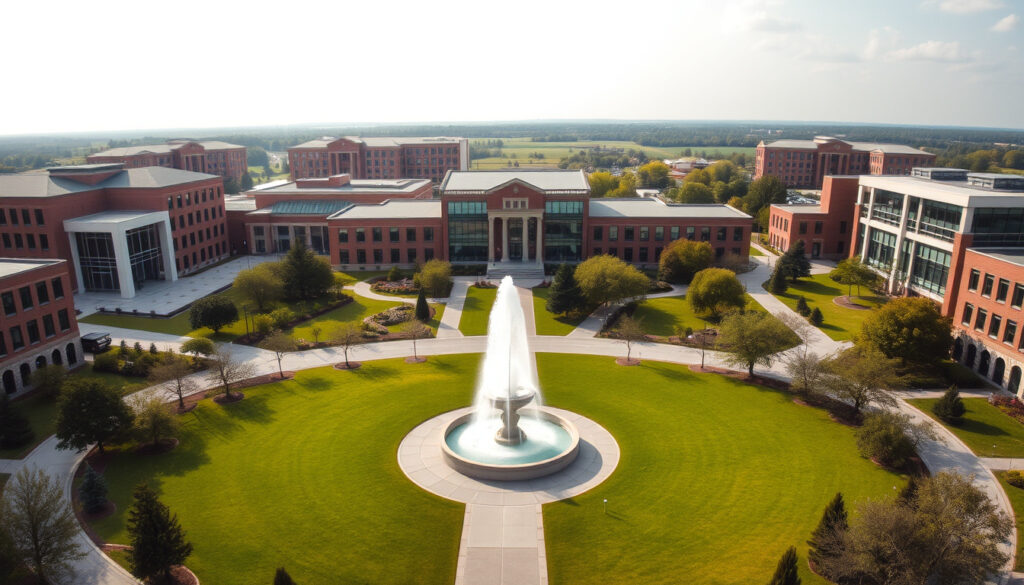
University of Central Florida: Rankings, Acceptance Rate, and More
For a university that started as a small night-school program for missile technicians, the University of Central Florida has grown into something few predicted: one of the largest campuses in the country and a recent member of Forbes’s “New Ivy” list. With more than 70,000 students and a 36% acceptance rate, UCF is both accessible and increasingly selective—a rare combination that raises natural questions about prestige, graduation rates, and what the “You Can’t Finish” nickname really means.
Total enrolled students: 70,674 (fall 2025) ·
Acceptance rate: 36% ·
In-state undergraduate tuition: $6,368 ·
Founded: 1963 ·
U.S. News national ranking: #98
Quick snapshot
- Acceptance rate 36% (College Board BigFuture)
- Average admitted GPA 4.26 (UCF Facts 2025-2026)
- Forbes New Ivy (2026) (Forbes New Ivies 2026) (College Board BigFuture)
- Exact origin of ‘You Can’t Finish’ nickname remains anecdotal.
- Long-term prestige impact of Forbes New Ivy designation is uncertain.
- UCF’s standing relative to other Florida public universities in National Merit Scholars enrollment.
- The precise impact of location on student experience and outcomes.
- UCF continues to expand research funding ($237.4M in FY2025) (UCF Facts 2025-2026).
- New Ivy label may attract higher-achieving applicants. (UCF Facts 2025-2026)
| Attribute | Value |
|---|---|
| Founded | 1963 |
| Total enrollment | 70,674 |
| Acceptance rate | 36% |
| In-state tuition & fees | $6,368 |
| Six-year graduation rate | 73% |
| U.S. News ranking | #98 |
| Forbes New Ivy (2026) | Yes |
Is UCF really hard to get into?
UCF’s admissions profile places it in the “moderately selective” category. The university received more than 54,000 applications for the fall 2025 freshman class and accepted about 36%, according to College Board BigFuture (admissions data). That selectivity aligns with national benchmarks for large public research universities.
What is UCF’s acceptance rate?
The official acceptance rate stands at 36%, based on UCF’s own 2025-2026 facts page. The middle 50% SAT range is 1210–1340, and the ACT range is 25–29, per BigFuture.
UCF’s scale means even a 36% acceptance rate yields a freshman class of nearly 8,000 students. The university is selective but not elite—a middle ground that makes it a viable safety for strong students and a reach for others.
What GPA does UCF require?
UCF does not publish a minimum GPA, but the average high school GPA of admitted freshmen for fall 2025 was 4.26 on a weighted scale, as reported on the UCF Facts page. The earlier freshman class (2024) averaged 4.05, according to the UCF Office of Undergraduate Studies.
The implication: a B-average in honors/AP courses likely puts a student below the middle of the admitted pool.
The implication: UCF’s selectivity is genuine, but its scale tempers the exclusivity. The university remains accessible to a wide range of students, making it a strong option for both safety and reach applicants.
Is UCF a new ivy?
In 2026, Forbes included UCF on its “New Ivies” list—a designation meant to highlight schools that produce strong graduate outcomes without the brand of the original Ivies. The selection stirred comparisons with the University of Florida, which also made the list.
What is the Forbes New Ivies list?
Forbes’s New Ivies are private and public universities that “offer a top-notch education, high graduation rates, and strong post-graduation earnings,” according to Forbes (New Ivies methodology, 2026). The 2026 list includes 20 public and private institutions, with UCF among the public group.
How did UCF qualify as a New Ivy?
UCF’s qualifying metrics include a six-year graduation rate of 78% (up from 73% in earlier years), a 90% freshman retention rate, and a low debt burden—70% of first-time graduates leave with no educational debt, according to UCF Facts 2025-2026. The university also leads all Florida institutions in degrees awarded annually (over 18,000).
Forbes did not rank UCF alongside Stanford or MIT. Instead, the New Ivy label signals value: strong outcomes relative to cost, not prestige in the traditional sense.
How does UCF compare to UF’s New Ivy status?
Both UCF and the University of Florida made the 2026 Forbes New Ivies list, but their profiles differ significantly. The table below highlights key differences.
Two Florida public universities, one pattern: UCF competes on scale and debt freedom, UF on selectivity and research intensity.
| Metric | UCF | UF |
|---|---|---|
| Total enrollment (fall 2025) | 70,674 | ~55,000 |
| Acceptance rate | 36% | ~23% (2024) |
| Six-year graduation rate | 78% | ~91% |
| Average SAT (middle 50%) | 1210–1340 | 1340–1480 |
| In-state tuition & fees | $6,368 | $6,381 |
| Forbes New Ivy (2026) | Yes | Yes |
| U.S. News national ranking | #98 | #30 |
Why this matters: UF’s lower acceptance rate and higher graduation rates give it a stronger traditional ranking, but UCF’s vastly larger scale and debt-free graduation rate make it a more accessible path to a degree that pays off.
Why is UCF called You Can’t Finish?
The nickname “You Can’t Finish” is a play on the UCF initials and has circulated among students and locals for decades. Its origin is anecdotal—no single event or policy officially spawned it—but it reflects a historical perception that UCF was difficult to graduate from on time.
What is the origin of the ‘You Can’t Finish’ nickname?
According to UCF’s official history, the university expanded rapidly in the 1990s and 2000s, which occasionally led to course shortages and scheduling challenges. That practical difficulty likely fed the rhyme. The nickname predates UCF’s modern emphasis on four-year pathways and retention programs.
Is UCF’s graduation rate lower than average?
No. UCF’s six-year graduation rate for the most recent cohort is 78%, as reported on the UCF Facts page. That is above the national average for four-year public universities (about 68%). The retention rate (first-time, full-time freshmen returning for sophomore year) is 90%, well above average.
“UCF leads all universities in Florida in conferring more than 18,000 degrees a year,” states the University of Central Florida (official facts page).
The catch: the nickname survives because it rhymes, not because the data supports it. UCF’s graduation rates are solid and above the national average.
What major is UCF most known for?
UCF is nationally recognized in several fields that align with Central Florida’s economic anchors—space, tourism, and simulation technology.
What are UCF’s top-ranked programs?
UCF’s Rosen College of Hospitality Management is ranked among the top hospitality programs globally. The School of Modeling, Simulation, and Training is a leader in its niche. UCF also houses the Florida Solar Energy Center and a prominent optics and photonics program.
Is UCF known for engineering?
Yes. The College of Engineering and Computer Science is the largest in the UCF system, with programs in aerospace, civil, mechanical, and computer engineering. UCF’s proximity to Kennedy Space Center and hundreds of simulation- and defense-related firms makes it a pipeline for aerospace talent.
What about hospitality and optics?
The Rosen College enrolls over 3,000 students and is located near Universal Orlando and Walt Disney World. UCF’s CREOL (College of Optics and Photonics) is one of only a few free-standing optics schools in the U.S. and attracts federal research funding.
The pattern: UCF invests heavily in programs that serve local industry needs—hospitality for tourism, optics for defense/space, engineering for simulation and aerospace.
Where is UCF located city and state?
UCF’s main campus is in unincorporated Orange County, Florida, about 13 miles east of downtown Orlando. The address: 4000 Central Florida Blvd, Orlando, FL 32816.
Is UCF in Orlando?
Yes. The main campus carries an Orlando mailing address and is served by Orlando’s Lynx bus system. The city also hosts the UCF Downtown Campus, which houses the College of Health Professions and Sciences and the School of Visual Arts and Design.
What is the main campus address?
4000 Central Florida Blvd, Orlando, FL 32816. The campus spans 1,415 acres and includes a 10,000-seat football stadium, a performing arts center, and the Hyatt Regency Grand Cypress (nearby for prospective visitor stays).
Beyond the main campus, UCF operates regional campuses in Daytona Beach, Cocoa, Ocala, Palm Bay, Sanford/Lake Mary, and Valencia College West.
Clarity: what we know and what’s still fuzzy
Confirmed facts
- UCF admissions rate is 36% (College Board BigFuture)
- UCF named a Forbes New Ivy in 2026 (Forbes)
- Six-year graduation rate 78% (UCF Facts 2025-2026)
- 70% of first-time graduates have no educational debt (UCF Facts 2025-2026)
What’s unclear
- Exact origin of the “You Can’t Finish” nickname remains anecdotal
- Long-term effect of the Forbes New Ivy designation on UCF’s academic brand
- UCF’s standing relative to other Florida public universities in National Merit Scholars enrollment
- The precise impact of location on student experience and outcomes
Voices from the community
“UCF’s inclusion among Forbes’s New Ivies reflects our commitment to student success, access, and economic mobility. We are proud to be recognized alongside institutions that are redefining value in higher education.”
— UCF spokesperson (response to Forbes New Ivy list, 2026)
“The New Ivies are schools that combine high academic standards with strong graduate outcomes. UCF’s scale and debt-free graduation rate made it a natural fit for the list.”
— Forbes education analyst, Forbes (methodology note, 2026)
“People still make the joke, but honestly I never met anyone who actually couldn’t finish. My adviser mapped out my four-year plan from day one.”
— Current UCF student, senior in mechanical engineering
For students considering UCF, the choice is clear: the university offers strong academic programs in engineering, hospitality, and optics at a price that often leaves graduates debt-free. The “You Can’t Finish” nickname is a tired rhyme, not a real risk. For Florida residents looking for value, UCF compares favorably with even the state’s flagship—and the Forbes New Ivy recognition adds a new answer to the question of prestige. The trade-off? A massive campus and large class sizes that can feel impersonal. But for the cost-conscious student who wants a degree that pays, UCF is hard to beat.
Related reading: Where is Purdue University? (university location, reputation, cost)
For context, the University of Floridas acceptance rate has also seen a significant drop in recent years, reflecting broader trends in Florida’s competitive higher education landscape.
Frequently asked questions
Is UCF considered a prestigious school?
UCF is not traditionally considered highly prestigious (U.S. News #98), but its Forbes New Ivy designation and strong outcomes give it a solid reputation, especially for specific programs.
What is UCF’s average SAT score?
For the fall 2025 freshman class, the average SAT was 1347, with a middle 50% range of 1210–1340, per College Board BigFuture.
Does UCF have a medical school?
Yes, UCF has a College of Medicine in Lake Nona, which offers an M.D. program and a Burnett School of Biomedical Sciences.
How big is UCF’s campus?
The main campus covers 1,415 acres and includes over 100 buildings. UCF is one of the largest universities in the U.S. by enrollment.
What are UCF’s colors and mascot?
UCF’s colors are black and gold. The mascot is the Knight (formerly Pegasus), and the athletic teams compete as the Knights.
Is UCF a party school?
UCF consistently ranks in the top 20–30 on Princeton Review’s “Party Schools” list, but the academic environment is serious given the scale.
How many campuses does UCF have?
UCF has one main campus in Orlando and regional campuses in Daytona Beach, Cocoa, Ocala, Palm Bay, Sanford/Lake Mary, and Valencia College West.
More related posts
 Does Instagram Notify When You Screenshot a Story? (2026)
 How to Identify Scabies – Burrows, Rash and Night Itch Guide
 Cast of Play Dirty Film – Michael Caine, Davenport Full Roles
 2023 Dodge Charger SRT Hellcat: Pricing, Specs & Theft Prevention
 Marquez Valdes-Scantling: Seahawks Release, Now with Cowboys
 National Association of Realtors: Lawsuit, Purpose & Differences
 Coin Laundry Near Me: Dublin Prices & Tips
 How to Enter Microsoft Link Code in Minecraft
