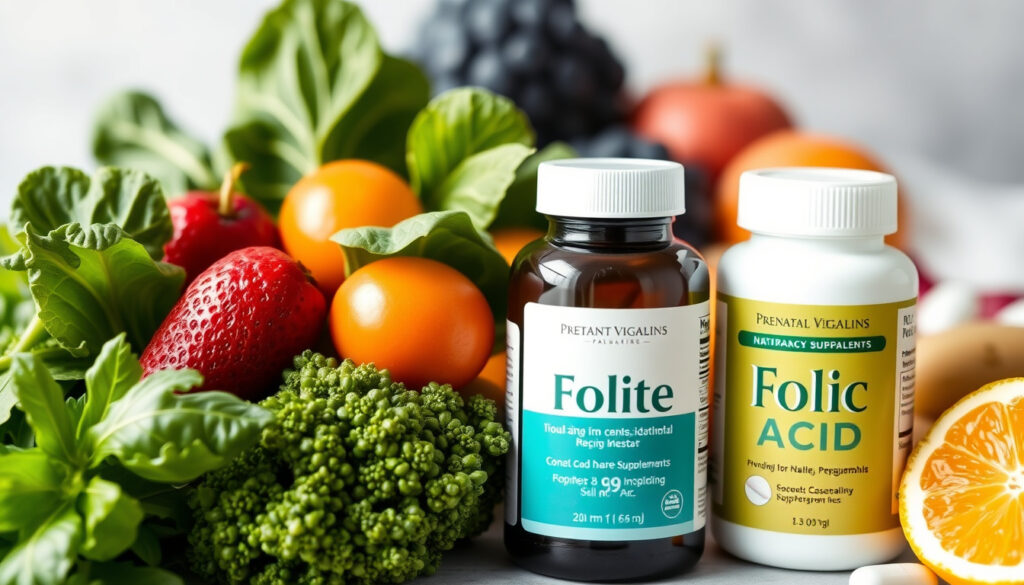
Folate vs Folic Acid: Differences, Sources, and Pregnancy Use
Folate and folic acid are not the same molecule, even though the supplement aisle often treats the names as interchangeable. This guide walks through the metabolic difference, why pregnancy advice specifically calls for folic acid, which foods deliver natural folate, and what to watch for when supplementing.
Adult RDA: 400 mcg DFE/day ·
Pregnancy supplement target: 400 mcg folic acid/day ·
Adult upper limit from supplements/fortified foods: 1,000 mcg folic acid/day ·
Active folate form in circulation: 5-methyltetrahydrofolate (5-MTHF)
Quick snapshot
- Natural vitamin B9 found in foods (NIH Office of Dietary Supplements)
- Found in leafy greens, legumes, asparagus (U.S. Office on Women’s Health)
- Counted as food folate in DFE (NIH ODS) (NIH Office of Dietary Supplements)
- Synthetic form used in supplements (MedlinePlus from the U.S. National Library of Medicine)
- Added to fortified grain products (CDC folic acid intake page)
- Requires DHFR conversion to active folate (Scaglione et al., 2014, academic review)
- Active folate form in circulation (Scaglione et al., 2014)
- Available as a supplement (NIH ODS)
- Bypasses the DHFR conversion step (Scaglione et al., 2014)
- 400 mcg folic acid daily is routinely recommended (CDC clinical overview)
- Food folate alone may not reach the target (UK National Health Service) (CDC clinical overview)
- Discuss MTHFR variants with a clinician (clinical guidance) (CDC clinical overview)
To get a side-by-side view of the basic differences between natural folate and its synthetic counterpart, these key facts lay out the numbers at a glance.
| Label | Value |
|---|---|
| Natural form | Folate |
| Synthetic form | Folic acid |
| Adult RDA | 400 mcg DFE/day |
| Prenatal supplement dose | 400 mcg folic acid/day |
| Adult upper intake level | 1,000 mcg folic acid/day from supplements/fortified foods |
Why folate and not folic acid?
What is the difference between methyltetrahydrofolate and folic acid?
- Folate is the naturally occurring form of vitamin B9 found in foods, whereas folic acid is the manufactured form used in supplements and fortified foods (NIH ODS).
- Folic acid must be converted by dihydrofolate reductase (DHFR) into the active form, 5-methyltetrahydrofolate (5-MTHF), which is the folate circulating in the blood (Scaglione et al., 2014).
- Folinic acid (leucovorin) and methylfolate are distinct reduced folate forms; they are not interchangeable with folic acid without clinical guidance (NIH ODS).
The conversion step is the bottleneck: people with certain MTHFR gene variants may have reduced DHFR activity, meaning synthetic folic acid is less efficiently converted. For them, methylfolate supplements might be an alternative — but routine pregnancy guidance still starts with folic acid.
The implication: The term “folate” on a food label and “folic acid” on a supplement bottle describe chemically different inputs. One is ready for your body to use after a single enzymatic step; the other requires two steps and a functioning DHFR enzyme.
What is the difference between folinic acid and folic acid?
Folinic acid (leucovorin) is a reduced folate used mainly in clinical settings, not a supplement substitute for folic acid. The two forms differ in structure and require clinical guidance before interchange (NIH ODS).
Is folate or folic acid better for pregnancy?
Why do pregnant people need folic acid?
Neural-tube development happens very early in pregnancy — often before a person knows they are pregnant. The CDC recommends that all women capable of becoming pregnant consume 400 micrograms of folic acid daily (CDC clinical overview). This dose has been shown to reduce the risk of neural tube defects by an estimated 50–70%.
Food folate alone is generally not relied on to meet the pregnancy supplement target. The UK National Health Service advises taking 400 micrograms of folic acid daily while trying to conceive and until the end of the first trimester at 12 weeks (UK National Health Service). Ideally, supplementation starts three months before attempting pregnancy. One pattern emerges from comparing folate intake from food versus folic acid from supplements during pregnancy:
| Attribute | Food folate | Folic acid supplement |
|---|---|---|
| Bioavailability | ~50% absorption (food matrix dependent) | ~85–100% absorption on empty stomach |
| Recommended dose for NTD prevention | Not established as a sole source | 400 mcg daily (standard public health guidance) |
| Effectiveness for NTD prevention | Supportive but insufficient alone | Proven in clinical trials to reduce NTD risk |
For pregnancy, the public health establishment is clear: take the synthetic form by supplement because it is more reliably absorbed and dosed, and the evidence for neural tube defect prevention is built on folic acid, not food folate.
Is methylfolate better than folic acid during pregnancy?
No high-quality evidence establishes methylfolate as superior to folic acid for routine neural-tube defect prevention. Folic acid remains the standard because the clinical trials behind NTD reduction used folic acid, not methylfolate.
The pattern: Public health guidance is dose-specific and supplement-based; methylfolate is a metabolic alternative for some people, but it is not the evidence-backed default for pregnancy.
What foods are high in folate?
Which vegetables are highest in folate?
- Dark green leafy vegetables: spinach, kale, collard greens, and Swiss chard (UK National Health Service)
- Cruciferous vegetables: asparagus, Brussels sprouts, broccoli, and cabbage (UK National Health Service)
- Legumes: chickpeas, lentils, kidney beans, black-eyed beans, and peas (UK National Health Service)
- Citrus fruits: oranges and orange juice provide natural folate (U.S. Centers for Disease Control and Prevention)
- Other sources: beets, corn, nuts, and animal liver (U.S. Office on Women’s Health)
The Mayo Clinic pregnancy nutrition guide lists approximately 131 micrograms in one-half cup of boiled spinach, 90 micrograms in one-half cup of boiled great northern beans, and 89 micrograms in four boiled asparagus spears (Mayo Clinic pregnancy nutrition guide).
Can I get enough folate from food alone?
Most adults can meet the 400 mcg DFE RDA with a varied, folate-rich diet. The pregnancy target is different: public health guidance does not rely on food folate alone to reach the 400 mcg folic acid supplement dose (UK National Health Service).
A balanced diet containing folate-rich foods does not replace the recommended folic-acid supplement for people who may become pregnant (UK National Health Service). Food labels use DFE (Dietary Folate Equivalents) to account for the lower absorption of natural folate, so a serving of spinach delivers less usable folate than the same number of micrograms of folic acid.
The implication: Natural folate is valuable across the lifespan, but the pregnancy standard is supplement-based because DFE adjustments show natural folate is less bioavailable than folic acid.
How to take folic acid?
Is it OK to take folic acid every day?
For most adults, 400 mcg folic acid per day is safe and effective for prevention. The Institute of Medicine sets the tolerable upper intake level from supplements and fortified foods at 1,000 mcg per day (NIH ODS Health Professional). Higher doses are used to treat deficiency under medical supervision.
A standard supplementation routine looks like this:
- Check the label for folic acid (not just folate) and note the mcg per serving.
- Take 400 mcg daily if you are planning pregnancy or following general prevention guidance, unless a clinician advises otherwise.
- Take it on an empty stomach with water for best absorption when the product label allows.
- Avoid combining separate supplements that both contain folic acid before adding the doses.
- Have B12 checked before long-term supplementation, especially if you are over 50 or have gastrointestinal concerns.
- Talk to a clinician about higher doses or if you take methotrexate or anticonvulsants.
What not to do while taking folic acid?
- Do not combine multiple supplement products containing folic acid (e.g., a multivitamin plus a separate folic acid pill) without checking the total dose — you may exceed 1,000 mcg.
- Folic acid can mask vitamin B12 deficiency, especially in older adults. Clinicians often check B12 levels before starting supplementation (NIH ODS).
- Avoid taking folic acid with large amounts of alcohol, which can impair folate metabolism.
What happens if my folic acid is too high?
Consistently exceeding 1,000 mcg per day from supplements/fortified foods may increase the risk of vitamin B12 deficiency going undiagnosed, and some studies have raised questions about high-dose folic acid and colorectal cancer risk — though the evidence is not conclusive (NIH ODS). The upper limit is a safety buffer, not a target.
If you have a history of gastrointestinal issues or are taking medications that interfere with folate metabolism (methotrexate, certain anticonvulsants), discuss your folic acid dose with a healthcare provider.
What are four signs your body may be lacking folic acid?
How do you feel when your folic acid is low?
- Fatigue and weakness — often the first noticeable symptom.
- Shortness of breath and pale skin due to megaloblastic anemia (UK National Health Service).
- Mouth sores, a smooth red tongue, and irritability.
- Poor growth in children and potential developmental delays.
What do you crave when your B12 is low?
Food cravings are not a reliable diagnostic sign for either folate or B12 deficiency. The overlap between the two deficiencies can create confusion because both can cause megaloblastic anemia, but B12 deficiency also includes neurological symptoms such as numbness, tingling, and cognitive changes (NIH ODS).
Confirmed facts
- Folate and folic acid are different forms of vitamin B9. (NIH ODS)
- Folic acid supplementation before conception reduces neural tube defect risk. (CDC)
- The adult upper limit for supplemental folic acid is 1,000 mcg per day. (NIH ODS)
- Folate deficiency can cause megaloblastic anemia. (NHS)
What’s unclear
- Whether high-dose folic acid raises or lowers cancer risk in specific populations is not settled.
- Whether methylfolate supplements are superior to folic acid for general pregnancy outcomes is not established.
- Whether folic acid improves hair growth in people without deficiency is not proven.
- Whether food folate alone provides the same neural-tube protection as folic acid supplements is not established; public health guidance defaults to supplements.
The diagnostic overlap: Folate and B12 deficiencies share an anemia pattern, so neurological symptoms and a clinician-checked B12 level separate the two.
Quotes from experts and agencies
All women capable of becoming pregnant should consume 400 micrograms of folic acid daily to help prevent neural tube defects.
— U.S. Centers for Disease Control and Prevention (CDC clinical overview)
Folate, folic acid, and 5-MTHF are not the same molecule. The synthetic form requires an enzymatic conversion step that many people assume is irrelevant.
— Scaglione et al., 2014 (academic review of folate metabolism)
Food labels use Dietary Folate Equivalents to account for the lower bioavailability of natural folate, so a serving of spinach delivers less usable folate than the same micrograms of folic acid.
— Registered dietitian, commentary on DFE conversion
What this means: Expert consensus separates chemical forms from dosing: folic acid is the public-health tool, while 5-MTHF is the circulating form that explains metabolic nuance.
For anyone planning a pregnancy, the choice is not between folate and folic acid — it’s about ensuring 400 mcg of folic acid daily, starting before conception. For others, a folate-rich diet with occasional fortified foods is likely sufficient. People who take folic acid with a multivitamin must add the doses, because combined totals can exceed the 1,000 mcg upper limit.
Frequently asked questions
Is vitamin B12 the same as folic acid?
No. Vitamin B12 (cobalamin) and folic acid are two different B vitamins. They work together in red blood cell formation, but they are chemically distinct and have different dietary sources and deficiency symptoms.
Why should you not take folic acid with B12?
You can take them together, but high-dose folic acid can mask a B12 deficiency by correcting the anemia without addressing the neurological damage. That’s why clinicians check B12 before starting folic acid.
Can folic acid help with hair growth?
There is no strong evidence that folic acid improves hair growth in people without a deficiency. Hair loss can be a sign of folate deficiency, but supplementing beyond a normal intake is not proven to regrow hair.
Can I take folic acid and folinic acid together?
Folinic acid (leucovorin) is a reduced form used in clinical settings to rescue cells from methotrexate toxicity. Combining it with folic acid is rarely needed and should be done only under medical supervision — they are not interchangeable supplements.
Should I take folic acid on an empty stomach?
Folic acid is best absorbed on an empty stomach with water. Taking it with food, especially high-fiber foods, can reduce absorption. Follow the supplement label instructions.
How long does it take for folic acid supplements to raise levels?
With daily supplementation, blood folate levels typically increase within a few weeks. For full correction of a deficiency, it may take 1–2 months of consistent dosing under medical guidance.
More related posts
 Bankruptcy Lawyers Near Me – Guide to Affordable Local Options
 TCG Card Shop Simulator Console? PS5, Switch, Xbox Guide
 Hero Fiennes Tiffin Movies: Filmography, After, Harry Potter
 Where to Watch The Hunger Games: Streaming Guide (2025)
 Detroit Tigers vs Cleveland Guardians: Rivalry Stats
 Chick-fil-A Sauce: Recipe, Ingredients, and Where to Buy
 University of Central Florida: Rankings, Acceptance Rate, and More
 A History of Violence – Plot, Cast, Themes Guide
