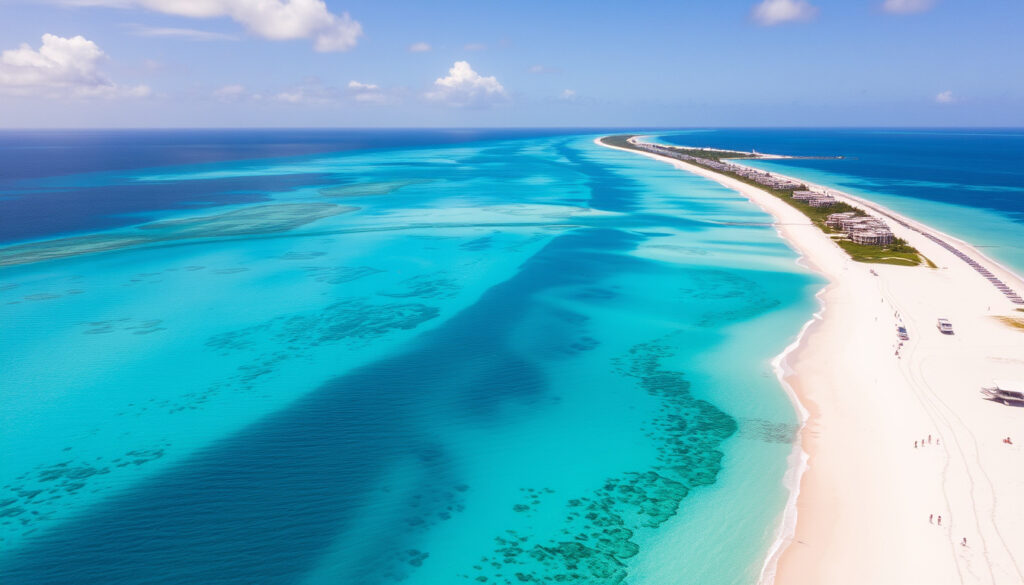
Where Is Turks and Caicos? Location, Safety & Cost Guide
You’ve seen the photos of turquoise water and powdery sand, but when someone asks “where is Turks and Caicos” you might hesitate. The short answer: it’s a British Overseas Territory in the Atlantic Ocean, about 575 miles southeast of Miami.
Location: Atlantic Ocean, 575 miles southeast of Miami ·
Governance: British Overseas Territory ·
Capital: Cockburn Town ·
Official language: English ·
Currency: US Dollar
Quick snapshot
- Atlantic Ocean, southeast of Bahamas (Visit TCI – Official Tourism Site)
- 925 km from Miami (Visit TCI – Official Tourism Site)
- British Overseas Territory (Visit TCI – Official Tourism Site)
- English official (Visit TCI – Official Tourism Site)
- Turks and Caicos Creole spoken locally (Visit TCI – Official Tourism Site)
- Low violent crime compared to region (US State Department – Travel Advisory)
- Strict firearm zero-tolerance (US State Department – Travel Advisory)
- High-end resorts common
- Groceries expensive
- Budget options available (self-catering)
Five key facts define Turks and Caicos for any traveler:
| Fact | Value |
|---|---|
| Political status | British Overseas Territory (Visit TCI – Official Tourism Site) |
| Capital | Cockburn Town (Grand Turk) |
| Population | ~45,000 |
| Currency | US Dollar (Visit TCI – Official Tourism Site) |
| Time zone | EST (UTC-5) |
The pattern: these five parameters define the territory’s identity, setting it apart from both US and independent Caribbean destinations.
Which country is Turks and Caicos in?
Political status
- Turks and Caicos Islands are a British Overseas Territory. This means the UK retains sovereignty, but the islands have their own government and laws. It is not part of the United States or any Caribbean nation. (Visit TCI – Official Tourism Site; Wikipedia – Turks and Caicos Islands)
- Nationality: people born in Turks and Caicos are British Overseas Territories citizens. For travel, US citizens need a passport but not a visa for stays under 90 days.
Geographic region
- The territory lies in the West Indies, part of the Lucayan Archipelago. It is located about 145 km north of Hispaniola (Haiti and Dominican Republic) and 925 km southeast of Miami. (UK Overseas Territories Conservation Forum – Geography)
- Two island groups make up the territory: the Caicos Islands (larger) and the Turks Islands (smaller), separated by the Turks Island Passage.
Because Turks and Caicos sits east of the Bahamas and north of Hispaniola, it shares the same Atlantic hurricane belt as Florida. If you’re planning a trip, the safest months are generally December through April. (Visit TCI – Weather Info)
The implication: despite its Caribbean location, its political allegiance to London and physical position east of the Bahamas give it a distinct identity.
How long is a flight to Turks and Caicos?
Flight times from major US cities
- Miami (MIA) to Providenciales (PLS): about 2 hours. (Wikipedia – Providenciales International Airport)
- New York (JFK) to PLS: roughly 4 hours. (Wikipedia – Providenciales International Airport)
- Los Angeles (LAX) to PLS: typically 6–7 hours with one stop.
If you’re comparing Caribbean destinations, check out our Map of Puerto Rico: Location, Cities, Beaches & Facts for another island territory with different flight options.
Airports serving the islands
- Providenciales International Airport (PLS) is the main gateway, handling most international flights. Direct service runs from Miami, New York, Charlotte, Atlanta, Toronto, and London.
- Smaller airports: Grand Turk (GDT), Salt Cay, South Caicos, and North Caicos – mostly served by inter-island flights.
The pattern: nearly all visitors arrive through Providenciales. If your resort is on the outskirts, you may still need a 20–40 minute drive.
What this means: for East Coast travelers, the flight is shorter than to many European or West Coast US destinations.
What language do people speak in Turks and Caicos?
Official language
- English is the official language and used in government, schools, and daily business. (Visit TCI – Official Tourism Site)
- All road signs, menus, and official forms are in English, making it easy for US and UK visitors.
Creole usage
- Turks and Caicos Creole (an English-based creole) is widely spoken among locals in casual conversation.
- Immigrant communities from Haiti and the Dominican Republic also speak Haitian Creole and Spanish. (Visit TCI – Official Tourism Site)
The implication: language is rarely a barrier for English-speaking travelers. You can get by with English everywhere, but you might hear Creole in markets and taxis.
Is Turks and Caicos safe?
Crime concerns
- Violent crime against tourists is low. The US State Department rates Turks and Caicos Level 2: Exercise Increased Caution (same as France, Italy, and the UK). (US State Department – Travel Advisory (March 4, 2025))
- Most crime occurs among residents in Providenciales, not in resort areas. (Visit TCI – Safety and Crime)
- By September 2024, the territory recorded 32 violent crimes. (Young Pioneer Tours – Safety Handbook)
Travel advisories and cautions
- Turkey and Caicos has a zero-tolerance policy for firearms and ammunition. Even a forgotten bullet in luggage can lead to arrest and jail time. (US State Department – Travel Advisory)
- Road safety is a concern: the traffic fatality rate is significantly higher than in the US, UK, or Canada. Drive defensively and avoid unmarked jitney taxis. (Visit TCI – Safety and Crime)
- Emergency number is 911. (Young Pioneer Tours – Safety Handbook)
The islands are still safer for tourists than many Caribbean destinations – the Bahamas has a higher US advisory level. But the combination of strict gun laws and road risks means “safe” comes with conditions. (White Villas – Safety Comparison)
The implication: for the cautious traveler who checks luggage thoroughly and drives defensively, the risk profile remains manageable.
Are Turks and Caicos expensive?
Accommodation costs
- Turks and Caicos is known for high-end resorts and private villas. Average hotel rates are among the highest in the Caribbean, often exceeding $500 per night for beachfront properties.
- Budget-friendly options exist: guesthouses, vacation rentals, and self-catering apartments can be found from $150 per night, especially on Grand Turk or Salt Cay.
Food and activity expenses
- Because most food is imported, grocery prices are 20–40% higher than in the US. A meal at a mid-range restaurant typically runs $30–50 per person.
- Activities like snorkeling, diving, and boat tours are priced comparably to other top Caribbean destinations – but transportation between islands adds cost.
The trade-off: the beauty is genuine, but you’ll pay a premium. Self-catering and choosing less developed islands can stretch your dollar.
Pros and cons of visiting Turks and Caicos
Upsides
- English-speaking and US dollar accepted – no currency confusion
- One of the safest Caribbean destinations for tourists (Visit TCI – Safety)
- Short flight from Miami (2 hours) and New York (4 hours)
- Stunning beaches (Grace Bay, Long Bay) and clear water
- No visa for US citizens under 90 days
Downsides
- High cost of accommodation, food, and activities
- Limited direct flights from the West Coast and Europe
- Strict firearm laws – risk of accidental violation
- Road fatality rate higher than US/UK (Visit TCI – Safety)
- Medical evacuation may be required for serious emergencies
The catch: the upsides are genuine, but the downsides demand preparation and budget flexibility.
What’s confirmed and what’s still unclear
Confirmed facts
- Turks and Caicos is a British Overseas Territory. (Visit TCI – Official Tourism Site)
- English is the official language. (Visit TCI – Official Tourism Site)
- Flight from Miami is about 2 hours. (Wikipedia – Providenciales International Airport)
- US Dollar is the official currency. (Visit TCI – Official Tourism Site)
- US State Department Level 2 advisory due to crime. (US State Department – Travel Advisory)
What’s unclear
- Exact flight time varies by airline and route (wind, stops).
- Safety levels change with travel advisories and local crime trends.
What experts and official sources say
“Turks and Caicos Islands are a British Overseas Territory.”
Wikipedia – Turks and Caicos Islands
“Located approximately 145 km north of Hispaniola.”
“Most crime occurs among residents, not tourists.”
More related posts
 401k Max Contribution 2025: Limits, Catch-Ups & SECURE 2.0
 NBA Games Tonight on TV: Schedule, Channels & Streaming
 Renta de Pickups Santo Domingo: Cheapest Prices & Guide
 Wells Fargo Active Cash Card Review: Pros, Cons & Fees
 Cast of Play Dirty Film – Michael Caine, Davenport Full Roles
 Bucked Up Energy Drink: Caffeine, Side Effects & Safety
 Where Is Yosemite National Park? Location & Yellowstone Guide
 How to Use chrome://flags: Desktop & Android Guide
