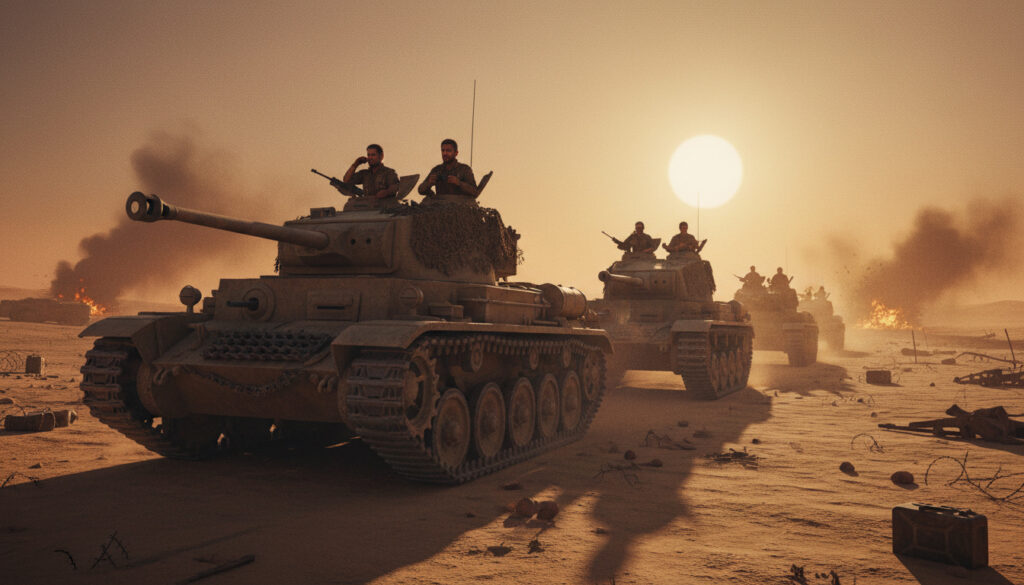
Cast of Play Dirty Film – Michael Caine, Davenport Full Roles
Play Dirty stands as a stark 1969 British war film that diverges from traditional heroic combat narratives. Directed by André de Toth in his final cinematic effort, the production stars Michael Caine as Captain Douglas, a petroleum executive thrust into military command alongside a unit of convicted criminals. The film draws loose inspiration from World War II special operations units including the Long Range Desert Group and the SAS, framing its narrative within the North African campaign against German forces.
The ensemble cast features Nigel Davenport as the cynical Captain Cyril Leech, Harry Andrews as the rigid Brigadier Blore, and Nigel Green as Colonel Masters, the architect of the morally ambiguous mission. Released in December 1969 after filming in Spain, the movie presents a gritty, morally complex alternative to contemporary war epics, emphasizing survival instinct over patriotic glory.
Who Is in the Cast of Play Dirty?
The 1969 production assembled a distinctive ensemble blending established British stars with character actors, creating a tense dynamic that drives the narrative’s exploration of institutional corruption and battlefield pragmatism. Wikipedia and Rotten Tomatoes provide comprehensive cast verification.
Key distinguishing elements separate this cast from conventional war films of the era:
- Michael Caine portrays an anti-hero captain, diverging from his earlier heroic roles
- Nigel Davenport delivers a breakout performance as the treacherous operational commander
- The unit comprises convicted criminals rather than professional soldiers, requiring actors to convey moral ambiguity
- Harry Andrews and Nigel Green provide the institutional military presence as senior officers
- Stanley Caine, Michael’s brother, appears briefly as a German Officer
- Richard Harris was originally contracted for a role but did not appear in the final film
- The supporting cast includes Patrick Jordan, Daniel Pilon, and international actors reflecting the North African setting
| Role Category | Actor / Details |
|---|---|
| Lead Actor | Michael Caine (Capt. Douglas) |
| Co-Star | Nigel Davenport (Capt. Cyril Leech) |
| Senior Command | Harry Andrews (Brig. Blore), Nigel Green (Col. Masters) |
| Supporting Cast | Patrick Jordan, Daniel Pilon, Bernard Archard, Aly Ben Ayed, Enrique Ávila, Mohamed Kouka, Takis Emmanuel |
| Special Appearances | Stanley Caine (German Officer), Vivian Pickles (German Nurse) |
| Additional Cast | Michael Stevens, Anthony Stamboulieh, Jose Halufi, Jeremy Child, Dennis Brennan, Rafael Albaicín |
| Director | André De Toth |
| Producer | Harry Saltzman |
| Screenplay | Melvyn Bragg |
| Release Date | December 1969 (UK) |
Who Plays the Lead Roles in Play Dirty?
The central conflict revolves around two captains with fundamentally opposing moral frameworks, portrayed by actors at contrasting career stages. IMDb and TV Guide archives confirm the complete billing.
Michael Caine as Captain Douglas
Caine embodies Captain Douglas, a British Petroleum executive seconded to the Royal Engineers to manage fuel logistics for the Eighth Army. His character possesses technical expertise in petroleum infrastructure yet lacks combat command experience, forcing him to navigate a unit of convicted criminals led by the insubordinate Leech. This role marked a significant departure from Caine’s earlier heroic portrayals, establishing his capacity for cynical, world-weary characters.
Nigel Davenport as Captain Cyril Leech
Davenport portrays Captain Cyril Leech, a convicted criminal who assumes operational command of the special raiding unit despite Douglas’s nominal leadership. The character exhibits calculated cynicism and treachery, ultimately betraying the mission parameters to ensure personal survival. MovieMeter records this as one of Davenport’s defining early roles, establishing his facility for morally ambiguous authority figures.
Harry Andrews and Nigel Green as Commanding Officers
Harry Andrews appears as Brigadier Blore, the commander who orders the fuel depot destruction mission under threat of unit disbandment, while Nigel Green plays Lieutenant Colonel Masters, the architect of the criminal unit concept. Their performances provide the institutional military structure against which the renegade unit rebels.
Stanley Caine, Michael Caine’s younger brother, appears uncredited as a German Officer during the infiltration sequences, marking a rare instance of the siblings sharing screen time in a theatrical release.
Who Directed Play Dirty and Key Crew?
The production crew combined veteran filmmakers with emerging talent, creating the technical foundation for the film’s gritty visual aesthetic. MovieMeter and the BFI provide definitive crew documentation.
André de Toth’s Final Directorial Effort
André de Toth directed the film while contributing to the screenplay adaptation, marking his final work behind the camera. The Hungarian-born director brought experience from Westerns and noir thrillers to the North African setting. Assistant directors included Carlos Gil, Antonio Tarruella, Roger Good, and Nick Caris Carter, managing the complex Spanish location shooting.
Writing and Production Team
Melvyn Bragg receives primary screenplay credit, adapting George Marton’s story with minimal contributions from Lotte Colin according to de Toth’s accounts. Harry Saltzman produced the film, bringing the same producing sensibilities that defined his work on the early James Bond franchise. The writing team crafted a narrative inspired by historical special forces operations while maintaining dramatic independence from specific documented events.
Technical Departments
Edward Scaife served as cinematographer, capturing the arid Spanish landscapes standing in for North African deserts. Alan Osbiston and Jack Slade handled editorial duties, while Michel Legrand conducted the musical score. Art direction fell to Maurice Pelling, Thomas N. Morahan, and Elven Webb, with special effects supervised by Kit West and makeup by Freddie Williamson.
Filming occurred primarily in Spain during 1968, utilizing the country’s desert terrain to represent WWII North Africa. This location choice influenced the visual authenticity that critics later noted as a distinguishing feature among British war films of the period.
What Is Play Dirty About?
The narrative follows a morally compromised mission behind German lines, blending heist film mechanics with war movie conventions.
Plot Summary
Captain Douglas manages fuel supplies for the British Eighth Army when Colonel Masters assigns him to lead a special unit composed of convicted criminals. Brigadier Blore orders the unit to destroy an Afrika Korps fuel depot or face disbandment. Masters selects Douglas specifically for his petroleum expertise despite objections from traditional military commanders. Leech, a criminal with command experience, gradually usurps operational control during the mission. The unit captures a German ambulance and nurse, faces internal violence including an attempted assault, and discovers their initial target is a decoy. Disguised as German soldiers, they infiltrate a heavily defended port only to face betrayal by Masters, who reveals their identities to enemy forces. Leech and Douglas escape amid explosions and casualties, including the German nurse killed by an injured teammate.
Historical Inspiration
The film draws inspiration from WWII North African special forces units, particularly the Long Range Desert Group and the Special Air Service (SAS), which conducted deep-penetration raids against Axis supply lines. However, the specific narrative involving convicted criminals serving in exchange for clemency represents dramatic invention rather than documented historical practice.
The film contains scenes depicting attempted sexual assault, prisoner mistreatment, and graphic wartime violence that distinguish it from contemporary war films marketed toward family audiences. These elements contributed to the film’s reputation for moral ambiguity and cynical tone.
When Was Play Dirty Produced and Released?
- : Principal photography commences in Spain, utilizing desert locations to represent North Africa. Assistant directors Carlos Gil and Antonio Tarruella manage the Spanish crew.
- : United Kingdom theatrical premiere, distributed to capitalize on Michael Caine’s rising international profile following The Italian Job.
- : United States theatrical release, where the film received limited distribution despite Saltzman’s producing credentials.
The production timeline reflects standard post-production schedules for British cinema of the era, with approximately one year separating principal photography from theatrical exhibition.
What Is Confirmed About the Production?
| Established Information | Information That Remains Unclear |
|---|---|
| Core cast confirmed via IMDb, Wikipedia, and TV Guide archives | Exact historical incidents inspiring specific plot beats remain debated among military historians |
| André de Toth’s final directorial credit verified by multiple film databases | Extent of Lotte Colin’s screenplay contributions uncertain; de Toth indicated minimal involvement |
| Filming locations in Spain confirmed by crew records | Original working title and early development history partially lost |
| Richard Harris signed for role but withdrew before filming | Specific reasons for Harris’s departure not fully documented |
| Runtime of 118 minutes confirmed by distribution records | Existence of deleted scenes or alternate cuts remains speculative |
How Does Play Dirty Fit in War Cinema?
Released the same year as The Italian Job, Play Dirty represents a deliberate departure from the heroic conventions established by earlier British war films like The Dam Busters or Ice Cold in Alex. Where those films celebrated military discipline and national solidarity, de Toth’s production emphasizes institutional betrayal, criminal pragmatism, and the futility of individual honor within corrupt systems.
The casting of Michael Caine proved strategic, leveraging his working-class persona from Alfie and The Italian Job but redirecting it toward cynicism rather than charm. This repositioning established a template for subsequent British anti-war films including Too Late the Hero and Cross of Iron. The film’s commercial performance, while modest compared to Caine’s contemporary releases, secured a cult following among enthusiasts of unconventional war cinema. Those interested in contemporary television productions might consult the New TV Shows 2025 – Complete Release Schedule for comparable ensemble casting in current series.
The supporting cast’s inclusion of international actors like Aly Ben Ayed and Mohamed Kouka reflected broader shifts in 1960s British cinema toward location authenticity and diverse ensemble construction, moving away from studio-bound productions with British actors in foreign makeup.
What Do Critics Say About the Cast?
Contemporary reception focused heavily on the lead performances, particularly the dynamic between Caine’s reluctant officer and Davenport’s criminal commander.
“A dirty dozen-style mission executed with notably less romanticism and significantly more moral corrosion.”
— Variety review, 1969
“The toughest shoot I’ve endured, working in those Spanish deserts with that particular ensemble.”
— Michael Caine, production interview
Secondary sources including Wikipedia and Rotten Tomatoes aggregate contemporary observations regarding the cast’s chemistry and the film’s departure from standard war movie heroics.
Why Does the Cast Matter?
The ensemble of Play Dirty (1969) established a new paradigm for British war cinema, replacing stiff-upper-lip heroism with pragmatic cynicism. Michael Caine’s portrayal of Captain Douglas and Nigel Davenport’s creation of Captain Leech provided templates for subsequent anti-heroic military narratives, while the supporting cast grounded the fantastic premise of criminal soldiers in visceral reality. For viewers researching nutritional supplements alongside film history, the Garden of Life Probiotics – 2025 Review and Buyer’s Guide offers unrelated consumer analysis. The film remains available through various streaming archives and specialty Blu-ray distributors for contemporary audiences seeking the complete cast performances.
Frequently Asked Questions
Is Play Dirty based on a true story?
The film draws loose inspiration from WWII special forces units like the Long Range Desert Group and SAS, but the specific plot involving convicted criminals serving as soldiers represents dramatic invention rather than documented history.
Who stars in Play Dirty with Michael Caine?
Nigel Davenport co-stars as Captain Cyril Leech, with Harry Andrews as Brigadier Blore and Nigel Green as Colonel Masters. Stanley Caine, Michael’s brother, also appears briefly.
Who directed Play Dirty?
André de Toth directed the film, marking his final directorial effort. He also contributed to the screenplay adaptation alongside Melvyn Bragg.
What is the runtime of Play Dirty?
The film runs 118 minutes in its standard theatrical release version.
Who plays the German Officer in Play Dirty?
Stanley Caine, Michael Caine’s younger brother, appears as a German Officer during the infiltration sequences.
Was Richard Harris in Play Dirty?
No. Richard Harris was originally signed to appear in the film but withdrew before production commenced; his role was recast.
Where was Play Dirty filmed?
Principal photography occurred in Spain during 1968, utilizing Spanish desert locations to represent the North African campaign settings.
Who wrote Play Dirty?
Melvyn Bragg wrote the screenplay based on a story by George Marton, with André de Toth contributing additional adaptation work.
More related posts
 Yeast Infection Symptoms: Signs, Causes & When to See a Doctor
 Best Diablo 4 Interactive Maps: Compare & Find Yours
 Renta de Pickups Santo Domingo: Cheapest Prices & Guide
 Does Instagram Notify When You Screenshot a Story? (2026)
 Lawn Care Near Me: Costs, Timing & Expert Tips for Ireland
 Sugar Mountain Ski Resort: Night Skiing & Planning Guide
 Where is New England? States, Map, and History Explained
