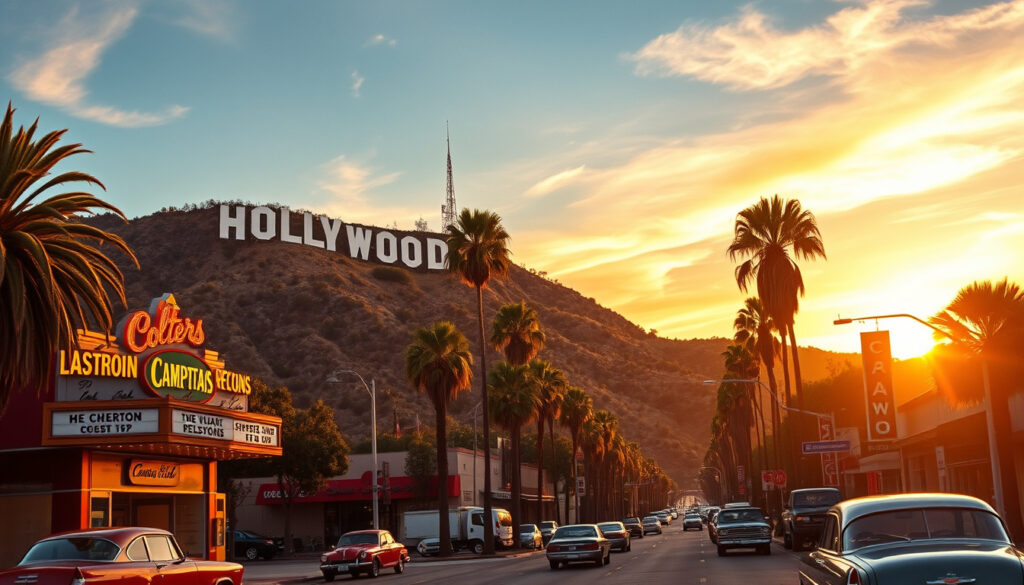
Once Upon a Time… in Hollywood – Plot, Cast and True Story
Quentin Tarantino’s ninth film takes audiences back to 1969 Los Angeles, weaving together the lives of a fading television star, his stunt double, and the real-life tragedy that would shake Hollywood. The film blends historical events with fictional narrative, creating an alternate version of events that has captivated audiences since its release.
Rather than retelling the Manson Family murders as they actually occurred, the story follows Rick Dalton and Cliff Booth as their paths cross with Sharon Tate and the dangerous figures lurking on the periphery of Hollywood’s golden age. The result is a meditation on a changing industry and an attempt to rewrite one of cinema’s most devastating true crimes.
The film received critical acclaim, commercial success, and sparked conversations about historical revisionism in cinema. Its attention to period detail and complex character portrayals earned it a place among Tarantino’s most ambitious works.
What is Once Upon a Time in Hollywood About?
The narrative unfolds over several months in 1969, centering on Rick Dalton (Leonardo DiCaprio), a former star of the 1950s television Western Bounty Law who fears his career is slipping away. Taking guest villain roles on shows like Lancer, Rick struggles with insecurity about his fading relevance while living next door to rising actress Sharon Tate and her husband, director Roman Polanski.
Rick’s closest companion is his stunt double and longtime friend Cliff Booth (Brad Pitt), a World War II veteran who drives Rick to appointments because of his multiple DUIs. Cliff faces professional barriers due to rumors that he killed his wife and a notorious fight with Bruce Lee. Living in a trailer with his pit bull Brandy, Cliff represents a working-class toughness increasingly out of place in the new Hollywood.
Key Insights
- The film presents an alternate history where the Manson Family attack is redirected away from Sharon Tate’s home
- Tarantino describes it as his “love letter to Los Angeles” during a pivotal transitional moment in entertainment
- Brad Pitt won the Academy Award for Best Supporting Actor for his portrayal of Cliff Booth
- The production design recreated 1969 Los Angeles with meticulous attention to period authenticity
- Historical figures like Sharon Tate, Roman Polanski, and Charles Manson appear alongside entirely fictional characters
- The film explores themes of professional decline and the end of Hollywood’s golden age
| Category | Details |
|---|---|
| Budget | $90–96 million |
| Box Office | $374.3 million worldwide |
| Rotten Tomatoes | 85% critics, 7.6/10 average |
| Metacritic | 84/100 |
| IMDb Rating | 7.6/10 |
| Oscars Won | 2 (Supporting Actor, Production Design) |
The Climactic Sequence
On August 8, 1969, the film reaches its pivotal moment when Manson Family followers Tex Watson, Sadie, Katie, and Flowerchild arrive at what they believe is their intended target. Their vehicle’s noise disturbs Rick, who shouts at them from his property. This interaction redirects them from Sharon Tate’s home to Rick’s house instead.
Under the influence of an acid cigarette, Cliff and Brandy engage the intruders in brutal combat. Brandy inflicts severe injuries on Tex, while Cliff kills both Tex and Katie using objects from around the house. Rick, unaware of the battle unfolding, emerges with a prop flamethrower from his shed and incinerates Sadie. The sequence concludes with Cliff hospitalized, and Rick subsequently befriending Sharon Tate and her surviving associates.
Tarantino’s revision places the attack at Rick Dalton’s fictional residence rather than the actual Cielo Drive location. In reality, Sharon Tate and four others were killed at 10050 Cielo Drive on August 9, 1969, by followers of Charles Manson.
Is Once Upon a Time in Hollywood Based on a True Story?
The film draws heavily from real historical events while departing from them at the most critical moment. The Manson Family murders of August 8-9, 1969, form the factual foundation upon which Tarantino constructs his fictional narrative. On those dates, followers of Charles Manson—Tex Watson, Susan Atkins, Patricia Krenwinkel, and Linda Kasabian—infiltrated the home at 10050 Cielo Drive in Benedict Canyon.
Sharon Tate, who was eight months pregnant, along with her husband Roman Polanski’s friends Jay Sebring, Wojciech Frykowski, Abigail Folger, and Steven Parent, were all killed that night. Manson reportedly sought Terry Melcher, a music producer who had previously lived at the residence and with whom he had personal grievances. According to sources like Wikipedia, the murders represented one of the most shocking crimes in Los Angeles history and marked the beginning of Manson’s criminal prosecution.
The Fictional Departure
Tarantino changes the outcome dramatically: Sharon Tate survives, and the Manson followers who attack Rick Dalton’s home are killed in the confrontation. The director has stated in interviews that he wanted to give the audience a different ending than what history provided. Rather than dwelling on the tragedy, the film imagines a scenario where Hollywood’s representatives fight back against the darkness that descended on their community.
Several supporting details rooted in reality appear throughout the film. Spahn Ranch, where Cliff confronts the Manson Family squatters, was indeed a location used by the group. George Spahn, portrayed as a blind elderly man, was the actual owner who permitted Manson followers to stay on his property. Charles Manson’s appearance at the Polanski residence, seeking Terry Melcher, reflects documented historical interactions that preceded the murders.
While Rick Dalton and Cliff Booth are entirely fictional, real people including Sharon Tate, Roman Polanski, Jay Sebring, and Charles Manson are depicted. Bruce Lee also appears as a character, portrayed by Mike Moh, in a scene depicting his encounter with Cliff Booth.
Who Is in the Cast of Once Upon a Time in Hollywood?
The ensemble cast brings together two of Hollywood’s biggest stars alongside relative newcomers and established character actors. Leonardo DiCaprio plays Rick Dalton, the conflicted fading star whose career anxieties drive much of the emotional arc. DiCaprio researched 1960s television actors to inform his portrayal of a man watching his industry transform around him.
Brad Pitt embodies Cliff Booth with a laid-back charisma that masks the character’s mysterious past. Pitt’s performance earned him the Academy Award for Best Supporting Actor. Margot Robbie portrays Sharon Tate with emphasis on her aspirational spirit and joy at achieving her dreams in Hollywood.
| Actor | Character | Role Description |
|---|---|---|
| Leonardo DiCaprio | Rick Dalton | Fading TV Western star struggling with career decline |
| Brad Pitt | Cliff Booth | Rick’s stunt double and loyal friend with a mysterious past |
| Margot Robbie | Sharon Tate | Rising actress and Polanski’s pregnant wife |
| Emile Hirsch | Jay Sebring | Tate’s friend and hairdresser |
| Rafal Zawierucha | Roman Polanski | Tate’s director husband |
| Austin Butler | Tex Watson | Manson Family member leading the attack |
| Mikey Madison | Sadie (Susan Atkins) | Manson follower killed during the climax |
| Madison Iseman | Katie (Patricia Krenwinkel) | Manson follower killed during the climax |
| Margaret Qualley | Flowerchild (Linda Kasabian) | Manson follower who flees before violence escalates |
Notable supporting performances include Mike Moh as Bruce Lee, whose cameo depicts a controversial encounter with Cliff Booth, and Damon Herriman as Charles Manson in a brief but unsettling appearance. Damien Lewis portrays Steve McQueen in another cameo, representing the older generation of Hollywood stars alongside Rick’s decline.
Character Relationships
The dynamic between Rick and Cliff forms the emotional core of the film. Their relationship transcends typical employer-employee boundaries, with Cliff serving as both practical assistant and psychological anchor for Rick’s anxieties. The film explores how these two men—neither fully suited to the changing industry around them—depend on each other’s company despite the professional imbalance.
Sharon Tate exists in the narrative as both a real person and a symbol of Hollywood’s promise. Her scenes, particularly one where she watches herself on screen in The Wrecking Crew, emphasize her genuine excitement about her career and upcoming motherhood. Her proximity to Rick’s home creates dramatic irony throughout the film, as audiences know the tragedy that nearly unfolds next door.
When Was Once Upon a Time in Hollywood Released and Who Directed It?
Quentin Tarantino directed the film, marking his ninth feature project and continuing his distinctive approach to genre filmmaking and historical revision. Tarantino wrote the screenplay specifically for DiCaprio and Pitt, crafting the roles with their screen personas in mind. The director, known for works like Pulp Fiction and Inglourious Basterds, described the project as his most personal love letter to cinema and Los Angeles.
The film premiered at the Cannes Film Festival on May 21, 2019, where it competed for the Palme d’Or before receiving a standing ovation. General theatrical release followed on July 26, 2019, in the United States. According to Rotten Tomatoes, the release timing coincided with the 50th anniversary of the Manson Family murders, adding weight to the film’s revisionist premise.
Production and Filming Locations
Principal photography occurred primarily in Los Angeles, with extensive efforts to recreate the 1969 cityscape. Rick Dalton’s house at 8909 West Hollywood Hills Drive serves as the fictional stand-in for the actual Tate-Polanski residence at 10050 Cielo Drive, which was demolished in 1971. The production team transformed existing locations to capture the architectural character of the era.
Spahn Ranch sequences were filmed at Corral Canyon in Malibu, recreating the real Manson Family squatting location. The Playboy Mansion featured in a pivotal party sequence. Television set construction for Lancer took place at Warner Bros. Studios in Burbank. Italian sequences depicting Rick’s spaghetti Western work were simulated locally rather than filmed abroad.
The film’s Academy Award-winning production design team recreated 1969 Los Angeles with vintage automobiles, period-appropriate signage, and carefully selected locations. Barbara Ling’s work earned her the Oscar for Best Production Design in 2020.
Critical Reception and Awards
The film received widespread critical acclaim. Reviewers praised the performances of DiCaprio and Pitt, with particular attention to their on-screen chemistry. Tarantino’s direction and the film’s nostalgic atmosphere earned positive responses, though some critics noted the extended runtime and deliberate pacing.
At the 92nd Academy Awards, the film won two Oscars: Best Supporting Actor for Brad Pitt and Best Production Design for Barbara Ling and Nancy Haigh. It received ten total nominations including Best Picture, Best Director, and Best Original Screenplay. Additional recognition included three Golden Globe wins and the Cannes Film Festival’s Palme d’Or runner-up position.
Timeline of Key Events
The production and release followed a concentrated schedule that positioned the film for major awards consideration.
- 2018: Principal photography takes place in Los Angeles with extensive location work
- May 21, 2019: World premiere at the Cannes Film Festival competition
- July 26, 2019: General theatrical release in United States theaters
- 2019-2020: Awards season campaign with major nominations and wins
- February 9, 2020: Brad Pitt wins Best Supporting Actor at the Academy Awards ceremony
What the Film Gets Right and What Remains Unclear
Established Facts
- Sharon Tate and Roman Polanski lived at 10050 Cielo Drive in 1969
- Charles Manson sought to contact Terry Melcher at that residence
- Real murders occurred August 8-9, 1969, killing five people including Tate
- Spahn Ranch was used by Manson followers
- Tate was pregnant at the time of her death
- Real perpetrators were followers of Charles Manson
Ambiguous Elements
- Whether Rick Dalton’s character is based on any specific actor remains unconfirmed
- The extent of Tarantino’s artistic license with Cliff Booth’s backstory is unknown
- No official confirmation of potential sequel plans exists
- The accuracy of depicted Hollywood social dynamics in 1969 cannot be fully verified
The Significance of Tarantino’s Revision
The film’s alternate history approach represents a deliberate choice to engage with tragedy through imagination rather than documentation. Tarantino has stated that he wanted to give Tate the life that was stolen, imagining a scenario where Hollywood protected its own on that fateful night.
This approach has drawn both praise and criticism. Supporters view it as a powerful act of storytelling that acknowledges real horror while refusing to be consumed by it. Detractors argue that revising history, particularly around violent events, raises ethical questions about representation and memory.
The thematic resonance extends beyond the Manson Family connection. By centering Rick Dalton’s professional anxieties alongside the looming tragedy, the film positions its fictional narrative as equally important as documented history. Both threads explore vulnerability—the vulnerability of careers and the vulnerability of lives.
Tarantino frames the film as an act of homage rather than exploitation, dedicating the work to Los Angeles and the entertainment industry that shaped him. The final scene, showing Rick and Tate meeting as friends, underscores this celebratory intent.
Sources and Critical Perspectives
Multiple sources document both the real events that inspired the film and the production itself. Comprehensive information appears in film industry databases and entertainment publications that covered the awards season.
The film represents Tarantino’s most ambitious attempt to blend fiction with historical tragedy, creating a work that functions as both entertainment and memorial.
— Critical analysis of the film’s thematic approach
Primary production information derives from studio sources, interviews with cast and crew, and official Academy records. Historical context comes from documented accounts of the Manson Family murders and their cultural impact. Critical reception data comes from aggregated review platforms like Rotten Tomatoes and Metacritic.
Summary
Once Upon a Time in Hollywood stands as Quentin Tarantino’s love letter to a transformative era in Los Angeles history. By combining real events—the Manson Family murders—with entirely fictional characters like Rick Dalton and Cliff Booth, the film creates a revisionist narrative that imagines an alternate outcome for one of Hollywood’s darkest chapters.
The film’s success, both critically and commercially, demonstrates audience appetite for thoughtful engagement with historical trauma. Its celebration of industry friendship, critique of professional obsolescence, and ultimately hopeful conclusion offer multiple entry points for viewers. For those exploring similar themes of friendship and professional reinvention, our guide to A History of Violence – Plot, Cast, Themes Guide provides additional context on films exploring complex character dynamics.
Frequently Asked Questions
Did Once Upon a Time in Hollywood win any Oscars?
Yes. The film won two Academy Awards: Best Supporting Actor for Brad Pitt and Best Production Design. It received ten total nominations including Best Picture and Best Director.
Is there a Once Upon a Time in Hollywood sequel?
No sequel has been officially announced. Director Quentin Tarantino has stated that the film concludes his fictional account of 1969, though he has not ruled out future projects set in that era.
Where can I watch Once Upon a Time in Hollywood?
The film has been released on multiple streaming platforms following its theatrical run. Availability varies by region and platform agreements.
What happened to Sharon Tate in the movie?
In the film, Sharon Tate survives the Manson Family attack thanks to the alternate timeline. She appears in several scenes watching her films, preparing for motherhood, and befriends Rick Dalton after the climactic confrontation.
Who directed Once Upon a Time in Hollywood?
Quentin Tarantino directed the film, which serves as his ninth feature. He also wrote the screenplay specifically for Leonardo DiCaprio and Brad Pitt.
How accurate is the film to real history?
The film departs from real events at its climax. While depicting actual historical figures like Sharon Tate and Charles Manson, and real locations like Spahn Ranch, the ending presents an alternate history where Tate survives and the Manson followers are killed.
What is the runtime of the film?
The theatrical runtime is 161 minutes, making it Tarantino’s longest feature film to date.
More related posts
 What Is Popcorn Lung? Symptoms, Causes & Treatment
 Mexico National Football Team 2026 Matches: Schedule & Results
 We Didn’t Start the Fire Lyrics – Full Text, History and Meaning
 James Norton Movies and TV Shows: Career Guide
 Why Most Small Businesses Overpay for Accounting Software — and What to Do About It
 Garden of Life Probiotics – 2025 Review and Buyer’s Guide
 Cristiano Ronaldo Net Worth 2025: Is He a Billionaire
 Chick-fil-A Sauce: Recipe, Ingredients, and Where to Buy
