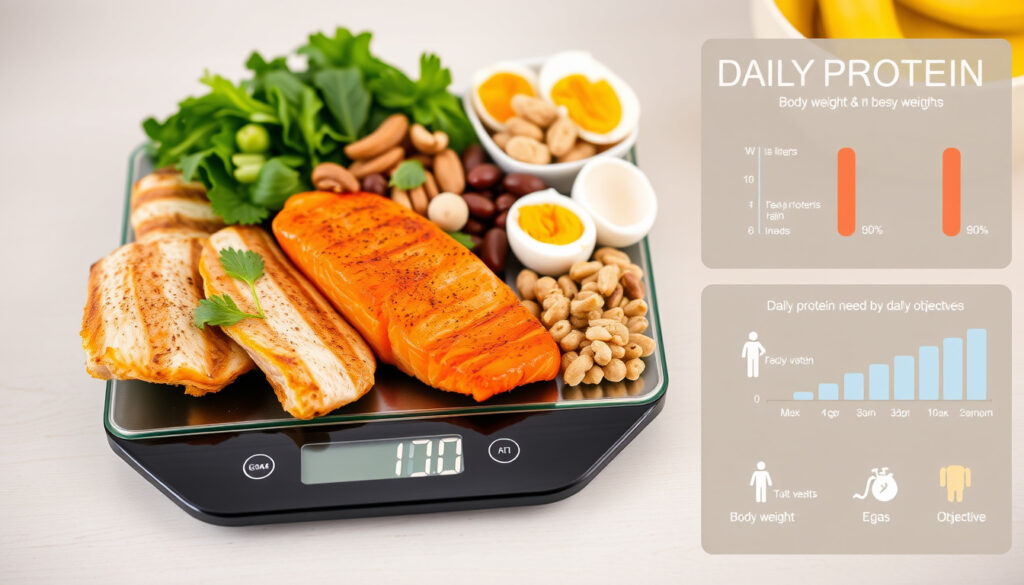
How Many Grams of Protein a Day – Needs by Weight and Goals
Whether the goal is maintaining general health, building muscle, losing weight, or supporting aging bodies, protein plays a fundamental role. Health organizations including the National Institutes of Health and the Dietary Guidelines for Americans provide structured recommendations that serve as starting points for planning dietary intake.
How Many Grams of Protein Should I Eat Per Day?
The foundational recommendation from health authorities sets the baseline at 0.8 grams of protein per kilogram of body weight daily for adults aged 19 and older. For the average sedentary adult male weighing approximately 70 kilograms, this translates to about 56 grams per day. For the average sedentary adult female weighing around 57 kilograms, the target is approximately 46 grams daily.
These figures represent minimum amounts needed to prevent deficiency in most healthy individuals. The Acceptable Macronutrient Distribution Range (AMDR) places protein at 10-35% of total daily calories, providing flexibility for different dietary patterns and goals.
To estimate your baseline RDA in grams, multiply your weight in kilograms by 0.8. For example, a person weighing 75 kg would need approximately 60 grams of protein per day at the sedentary baseline level.
| Age Group | Daily Recommendation (g/day) | Notes |
|---|---|---|
| Children 1-3 years | 13g | Both genders |
| Children 4-8 years | 19g | Both genders |
| Children 9-13 years | 34g | Both genders |
| Males 14-18 years | 52g | Growth phase |
| Females 14-70+ years | 46g | Stable from age 14 |
| Males 19-70+ years | 56g | Stable from age 19 |
| Pregnant/Lactating | 71g | Increased needs |
Protein Needs for Women
Adult women generally require 46 grams of protein per day as a baseline, according to Medical News Today and UC Davis Nutrition. This recommendation assumes average body weight and sedentary to lightly active lifestyles. Women with higher muscle mass, those who exercise regularly, or those following certain dietary patterns may need more to support their metabolic needs and physical activity levels.
Protein Needs for Men
Adult men typically need 56 grams of protein daily at the baseline level, as documented by the Dietary Reference Intakes. This reflects the generally larger average body size and higher muscle mass compared to women. Active men or those engaged in regular strength training often require significantly more to support muscle repair and growth.
The RDA of 0.8g/kg meets the needs of approximately 97-98% of healthy adults. Individual requirements may fall above or below this average depending on metabolic factors, health status, and physiological demands.
- The baseline RDA for healthy adults is 0.8 grams per kilogram of body weight daily
- Adult men average 56g/day while adult women average 46g/day at baseline
- Protein should comprise 10-35% of total daily caloric intake according to AMDR guidelines
- The Daily Value listed on nutrition labels is 50g for a 2,000-calorie diet
- Pregnancy and lactation increase needs to approximately 71g/day
- Growing children and teenagers have higher protein needs relative to body weight
- Health Canada sets similar standards, with the UK RNI slightly lower at 0.75g/kg
How Much Protein Do I Need Based on Weight and Goals?
Calculating personalized protein needs requires adjusting the baseline recommendation according to body weight and activity level. The simple formula involves multiplying weight in kilograms by the appropriate grams-per-kilogram factor for your situation. A 68-kilogram person engaging in moderate exercise would calculate their needs as 68 × 1.3, resulting in approximately 88 grams of protein daily.
Calculating Your Daily Protein Intake
The calculation method varies depending on individual factors. For general health maintenance, the baseline 0.8g/kg applies. For athletes and those seeking muscle growth, recommendations increase to 1.2-1.6g/kg according to the MD Anderson Cancer Center. Converting pounds to kilograms is straightforward: divide your weight in pounds by 2.2.
| Goal/Activity Level | Grams per kg/day | Example (70kg person) |
|---|---|---|
| Sedentary/Baseline | 0.8g | 56g |
| Lightly Active | 1.0-1.2g | 70-84g |
| Moderately Active | 1.3g | 91g |
| Intensely Active | 1.4-2.0g | 98-140g |
| Muscle Building | 1.6-2.0g | 112-140g |
| Weight Loss | 1.8-2.3g | 126-161g |
Protein for Muscle Building
Those aiming to build muscle mass or improve athletic performance typically need 1.2 to 1.6 grams of protein per kilogram of body weight daily, according to UCLA Health. Some research suggests optimal synthesis occurs at 1.5 to 2.0g/kg for serious strength athletes. This elevated intake supports muscle protein synthesis, the process by which the body builds new muscle tissue in response to resistance training.
Protein for Weight Loss
Weight loss efforts often benefit from higher protein intake, with recommendations reaching up to 2.3g/kg daily to preserve lean muscle mass while creating a caloric deficit. The American Heart Association notes that protein’s satiety effects can help reduce overall calorie consumption while maintaining muscle mass during weight loss.
Exceeding 35% of daily calories from protein may pose health risks for some individuals. While no strict Upper Limit (UL) for protein has been established, excessive intake should be approached cautiously, particularly for those with pre-existing kidney conditions.
Protein Recommendations for Special Groups
Certain populations have protein requirements that differ from general adult recommendations. These special cases reflect physiological changes, medical considerations, or dietary restrictions that affect how the body processes and utilizes protein.
Protein Needs for Older Adults
Adults over 65 years of age face unique protein-related challenges including sarcopenia, the progressive loss of muscle mass and strength associated with aging. Expert groups including PROT-AGE and ESPEN recommend 1.0-1.6g/kg daily for seniors, with 1.5g/kg representing an optimal level for maximizing muscle protein synthesis while remaining within the 10-35% calorie range. Research published in PubMed Central supports these higher allocations to counteract age-related muscle decline.
Kidney Patients
Individuals with kidney disease present an exception to higher protein recommendations. The Administration for Community Living notes that those with compromised kidney function should maintain protein intake at or below the standard RDA. Elevated protein can strain already-impaired kidneys, making medical supervision essential for this population.
Vegan and Plant-Based Diets
Those following vegan diets have the same baseline requirement of 0.8g/kg, adjusted based on activity and goals. Plant-based protein sources may require careful combination to ensure adequate intake of all essential amino acids, though current evidence suggests most vegans meeting total protein needs achieve sufficient amino acid profiles. Academy of Nutrition and Dietetics resources indicate that well-planned plant-based diets adequately support protein needs across all life stages.
How Much Protein Per Meal and Daily Limits?
How protein is distributed throughout the day affects how efficiently the body uses it. Research indicates that consuming 20-40 grams of protein per meal optimizes muscle protein synthesis, particularly when meals are spaced 3-4 hours apart. Three meals containing roughly equal protein portions generally provide better muscle-building outcomes than concentrating protein in a single meal.
Safe Upper Limits and Potential Risks
While no formal Upper Limit exists for protein, research suggests that intakes up to 2.0-2.3g/kg daily are generally safe for most healthy individuals. Consuming substantially more than this threshold may contribute to health issues, particularly when protein comprises consistently more than 35% of total caloric intake. According to Harvard Health, very high protein diets warrant monitoring, especially for those with existing health conditions.
Consequences of inadequate protein intake include malnutrition, muscle wasting, decreased immune function, and impaired physical performance. Athletes, seniors, and those recovering from illness face heightened risk of these complications when protein needs go unmet.
Aim to distribute protein evenly across 3-5 meals, targeting 20-40g per serving. This approach maximizes the body’s ability to utilize protein for muscle maintenance, repair, and growth throughout the day.
The Evolution of Protein Recommendations
Understanding the historical development of protein guidelines provides context for current recommendations. The establishment of Recommended Dietary Allowances began in 1943 with the first comprehensive set of nutritional standards. The framework evolved significantly in 1989 when the 0.8g/kg standard was formalized for healthy adults, replacing earlier estimates.
- 1943: First comprehensive RDA framework established, setting foundational nutritional standards
- 1989: Protein RDA standardized at 0.8g/kg body weight for adults
- 2002: ISSN Position Stand published on protein and exercise, introducing activity-based recommendations
- 2015-2020: Dietary Guidelines for Americans incorporated protein within macronutrient distribution ranges
- Present: Current guidelines emphasize individualized approaches based on age, activity, and health status
What We Know and What Remains Uncertain
Research has established certain protein requirements with confidence while other areas continue to evolve as scientific understanding advances. Distinguishing between established findings and ongoing areas of study helps frame realistic expectations for dietary planning.
| Established Information | Areas of Ongoing Research |
|---|---|
| RDA baseline of 0.8g/kg for healthy adults | Optimal protein intake for elite athletes in specific sports |
| Increased needs during pregnancy and lactation | Precise thresholds for muscle protein synthesis in various populations |
| Higher needs for older adults (1.0-1.6g/kg) | Long-term effects of very high protein diets (above 2.3g/kg) |
| Safety of moderate protein increases for most healthy people | Individual variation in protein requirements based on genetics |
| 10-35% AMDR for daily calories | Optimal meal timing relative to exercise |
Understanding Protein in Context
Beyond simple quantity, protein quality and dietary context influence how effectively the body meets its needs. The Protein Digestibility Corrected Amino Acid Score (PDCAAS) evaluates protein sources based on amino acid composition and human digestibility. Animal proteins generally score higher on this scale, though plant proteins can be combined to achieve complete amino acid profiles. For those interested in tracking macronutrients and ensuring adequate protein intake, the best macro calculator apps can help monitor daily consumption and identify potential gaps in nutritional planning.
Individual factors affecting protein needs include metabolic rate, digestive efficiency, gut health, and overall dietary composition. Those with compromised digestive systems may absorb protein less efficiently, potentially requiring higher intake to achieve the same outcomes.
“The Recommended Dietary Allowance for protein is 0.8 grams of protein per kilogram of body weight per day for healthy adults.”
— National Institutes of Health / Office of Dietary Supplements
“For building and maintaining muscle mass, athletes should aim for 1.4–2.0 grams of protein per kilogram of body weight daily.”
— International Society of Sports Nutrition Position Stand
Summary and Practical Recommendations
Meeting protein needs effectively requires considering individual factors while working within evidence-based guidelines. The foundational 0.8g/kg RDA provides a starting point for most healthy adults, with adjustments made for activity level, age, and specific goals. Those seeking muscle gain, weight loss, or managing the effects of aging typically benefit from higher intakes within the safe range of 1.2-2.3g/kg daily.
For those looking to incorporate more protein through whole foods and beverages, exploring Best Smoothie Recipes for Weight Loss – Low-Cal High-Protein Options can provide practical meal ideas that support protein goals while maintaining caloric balance. Understanding individual needs and distributing protein evenly throughout the day forms the cornerstone of effective nutritional planning.
Frequently Asked Questions
Is 100 grams of protein a day too much?
For most healthy adults, 100 grams of protein daily falls within a safe and reasonable range, particularly for those who are active or have higher body weight. A 70kg sedentary person would exceed their baseline RDA at this level, but athletes or those building muscle may find 100g appropriate for their goals.
How much protein do I need to build muscle?
Building muscle typically requires 1.2-2.0 grams of protein per kilogram of body weight daily. The exact amount depends on training intensity, current muscle mass, and individual response. Spreading this intake across multiple meals optimizes muscle protein synthesis.
What happens if I eat too much protein?
Consuming protein substantially above 2.0-2.3g/kg daily for extended periods may strain kidneys in susceptible individuals, contribute to digestive discomfort, and potentially lead to nutrient imbalances. Most healthy people can safely metabolize higher protein intakes, but extremes warrant caution and medical monitoring.
Can I get enough protein on a vegan diet?
Vegans can meet protein needs through diverse plant sources including legumes, soy products, grains, nuts, and seeds. Combining complementary protein sources throughout the day ensures adequate intake of all essential amino acids. Plant-based protein requires slightly more attention to total intake and amino acid variety.
How should I distribute protein throughout the day?
Research supports consuming 20-40 grams of protein per meal, distributed across 3-5 meals. This approach maximizes muscle protein synthesis and provides steady amino acid availability. Including protein at each meal, rather than concentrating intake in a single meal, yields better results for muscle maintenance.
Do seniors need more protein?
Adults over 65 benefit from higher protein intake of 1.0-1.6g/kg daily to counteract age-related muscle loss (sarcopenia) and maintain functional strength. Protein becomes less efficiently utilized with aging, necessitating increased consumption to achieve similar muscle-building effects.
How do I calculate my exact protein needs?
Multiply your body weight in kilograms by the appropriate factor for your goals: 0.8 for maintenance, 1.2-1.6 for athletic performance, 1.6-2.0 for muscle building, or up to 2.3 for weight loss with muscle preservation. To convert pounds to kilograms, divide by 2.2.
More related posts
 Trader Joe’s Tote Bag: Price, Resale Frenzy & Boycott
 Lawn Care Near Me: Costs, Timing & Expert Tips for Ireland
 Anatomy of the Body: Organs, Systems & Pain Red Flags
 New England Patriots vs Denver Broncos Stats: All-Time Record
 Voting Rights Act of 1965: Definition, Impact, and Importance
 What Can Cats Eat? Safe Human Foods List
 Missouri Star Quilt Company: Free Patterns, Tutorials & Controversy
 Top of the Rock: Tickets, Height, and vs Empire State
